Will Brehm 1:45
Monisha Bajaj, welcome to FreshEd.
Monisha Bajaj 1:57
Thanks so much for having me, Will.
Will Brehm 2:00
So, what is Human Rights Education?
Monisha Bajaj 2:04
Sure. Well, a very basic definition of Human Rights Education is any teaching and learning that happens to impart values, notions, knowledge about human rights among learners. And human rights, most basically, are legal and ethical frameworks for human dignity. And they’ve existed for many, many, many years, in many traditions, in many cultural backgrounds but they were most kind of concretized after the Second World War, as nations came together in the wake of two world wars, looking at the horrors of the Holocaust, and the ravages of what happened there -trying to create a shared moral, ethical, legal framework for individuals, communities, nations living in peace and in dignity.
Will Brehm 2:52
And that framework -that moral, and ethical, legal framework- was through the United Nations?
Monisha Bajaj 2:57
Yeah, so the United Nations came about -the ideas for it had existed through the League of Nations and other proposals that had existed before World War Two. But after World War Two, as nations recovered from many different things on many different continents that were happening, the proposals really moved forward in terms of creating the architecture and the structure for the United Nations. And through that there was a proposal for a Universal Declaration of Human Rights that would codify some basic human standards for living together. The basic principles for which every human would be entitled to.
Will Brehm 3:35
And so human rights as a framework through the United Nations, that was in the 1940s, 1950s, but when did the Human Rights “Education” first emerge?
Monisha Bajaj 3:46
Sure, so actually, Human Rights Education as I mentioned, you know, you have these traditions and cultures where notions of human rights emerged for many years and education about rights and basic values of human dignity have existed in many cultures historically and through the years. But again, at this codification in 1948, through the Universal Declaration of Human Rights -through these 30 articles of this kind of milestone document that’s been translated thousands of times, all around the world- there is Article 26 that fundamentally in Part 1 says that everyone has a right to education. And notably, in Part 2 of that says that education should be directed to the strengthening of respect for human rights and fundamental freedoms. So, there was this awareness and the individuals who debated this document, there were three years of debates and, you know, arguing over language and getting the right terms and the right notions and the phrasing and the types of principles that would be in this document. There was a lot of debates about individuals who were educated that participated in the Holocaust. So, people who were medical doctors who were experimenting in awful ways on individuals: torture, murder, atrocities, and the Nazi indoctrination of youth through education during that time -during the Nazi regime. So, there was this perspective that it’s not just access to education, which is Part 1 of Article 26, but education for what? Education towards peace, tolerance, friendship among nations, the strengthening of fundamental freedoms, respect for human rights. So HRE has actually existed -since in that kind of formal form- since the creation of the document, the Universal Declaration of Human Rights.
Will Brehm 5:28
And who are some of the main proponents of Human Rights Education?
Monisha Bajaj 5:51
Sure. So, in that kind of debating, there were people from different nations. There was a lot of strong support from women from India and from the Dominican Republic, who are delegates in drafting this document for inclusive language around gender. In terms of education, a lot of the Latin American countries pushed the economic, social and cultural rights into the document. Obviously, some of the drafters that we know about were Rene Cassin of France. Different individuals who were leading philosophers and theorists of that time, Charles Malik of Lebanon -other individuals. And so, these debates were happening among this group of individuals. Eleanor Roosevelt chaired the council that drafted the declaration, but she didn’t actually participate in a lot of the drafting of it, which is a bit of a misconception that a lot of individuals have -that she was the main drafter of the declaration. So, these were all kind of leading scholars, philosophers, intellectuals of the time that had come together through this platform of the drafting committee to put in what they saw were the most important rights that each individual should have across societies. What’s interesting about that drafting committee, a lot of individuals bring up the cultural relativist critique. And actually, the strong support for the kind of universalism was from nations of the global South. The few that were involved at that time who had already become free -if we think about the period of 1948 a lot of the countries of Asia, South Asia, at least in Sub-Saharan Africa, were still under colonial rule. And a lot of the colonial powers didn’t want the universal language to be in there. Because that would mean that then the colonies that were under their rule would have to be entitled to these rights that they weren’t at that time giving them. So, there’s this misnomer, I think, right? Or this misconception these days that cultural relativism is something that global South nations are arguing for. But at this time in the 1940s it was actually the reverse: That European powers were arguing for cultural relativist language so that they could maintain you know, their power over the colonies that they had that were very lucrative for them. But a lot of that history is very hidden.
Will Brehm 7:40
So, when did it change to the critique being that cultural relativism was what the global North was doing?
Monisha Bajaj 7:47
Yeah, so that -there’s a really interesting book, it’s a long answer to that question but I would point any listeners towards this book by -I think the first name of the, I can’t remember the first name of the author, but the last name is Burke, and again, the name of the book also escapes me- but it’s a I think it’s something on Decolonizing human rights or something like that. And it talks very extensively -it’s about a 200-page book- about every debate through the process of drafting the declaration. And then how different nations, particularly Saudi Arabia, different representatives from there, switched the debate on cultural relativism to then be a debate about the western imposition of values in order to be able to resist some of the universal framing around the 60s and 70s that was coming out about bringing attention to nations that were not abiding by some of these standards and advancing human rights for all people in those countries.
Will Brehm 8:44
Yeah, I know in the 90s a lot of Asian nations, when they came together during the Vienna Conference, they explicitly stated that human rights should not be used to pressure nations into a universal direction. They kind of made this very interesting balance between, on the one hand, they recognized human rights as universal but at the same time, they didn’t want nations -particularly a Western nations- to pressure Asian nations into following a certain direction of human rights. And it makes me realize that this difference between cultural relativism and the universal notion of human rights I mean, its intention and obviously, as you’re saying changes over time, depending on which nations are advocating for the different sides.
Monisha Bajaj 9:36
Yeah, I mean, I think the history of that debate is a really productive area to look into because it’s so complex and it’s so interesting to look kind of from the 1940s to the present who is on each side of that debate and how that’s shifted over time and even within nations to look at who argues for each of that. I know in my own work my I know we’re talking right now about this new book, but in my previous book on Human Rights Education in India, I looked at kind of the different definitions of Human Rights Education that people have. And it definitely was a lot of individuals who had a bit more privileged status that were arguing for cultural relativism and that these notions can’t be imposed on us. We have Asian values, or we are not like those nations that want us to be like them. Whereas the communities kind of at the very bottom, particularly Dalit rights activists and organizations that I work with -Dalit is considered formerly called “untouchable” groups. A lot of the organizations that were advancing Human Rights Education were Dalit rights organizations. And what they were saying is that, “we do want these universal notions because then what it can allow us to do is advocate for rights that we’ve been denied for thousands and thousands of years”. And the individuals who were arguing for cultural relativism were individuals who would then be upset or disrupted by a change in social relations that had privileged them for a very long time. So, I think it’s also very fruitful to look within nations to see how different structures are arranged and when groups who are some of the most marginalized begin to use human rights framing and language, how then the cultural relativist critique comes from local elites that don’t want any disruption of the privileges and benefits that they’ve had for a very long time.
Will Brehm 11:15
Right. So, it can be particular interests domestically, can latch on to some of these international ideas to push their agenda forward.
Monisha Bajaj 11:23
Yeah. And who is attending the UN meetings where they’re arguing for cultural relativism? For example, in the declaration that you mentioned, in the Vienna conference, the individuals who represent nations are often from elites, right? So, when there’s not the parallel tracks for NGOs or civil society or social movements to be part of those conversations, only one side of the story often gets put forward. So, it would be interesting to see -I think the World Conference against Racism in Durban in 2001 was a very interesting conference where many NGOs, social movements, civil society groups were present alongside the government representatives, and particularly around Dalit rights and the human rights framing, as well as other issues globally. You had a very sort of tense conference where even government actors walked out of the conference because of the strong presence of civil society that were basically telling them when the government of certain countries would say, No, the situation is like this. The civil society actors would say, “No, it’s not. We are living this, we are working this”. And so, you had both voices and it was very difficult for governmental actors to be able to spin a story that wasn’t countered by anyone else because you had a strong presence of civil society there.
Will Brehm 12:39
Yeah. So, let’s switch or let’s change gears to this: How Human Rights Education is actually practiced. Is this something that we see civil society and NGO organizations practicing? Or are governments actually practicing it as well?
Monisha Bajaj 12:56
Yeah. What I think is really interesting about Human Rights Education is you have a sort of “from above” approach and a “from below”. And then a lot of kind of grassroots, transformative education, social justice education, you only have the “from below”, which is kind of empowerment education, trying to reach marginalized groups, bring some sort of Freirean-inspired consciousness raising education in order to empower them. With Human Rights Education, you have that. You have a lot of grassroots movements. This was particularly true in Latin America, during the time of authoritarian rule. A lot of organizations were working with communities to bring in Human Rights Education to build a political base for movements to overthrow authoritarianism. You see that in many different contexts. At the same time, from the 1990s forward, you have a very strong intergovernmental legitimization of human rights discourses and Human Rights Education, particularly through the Vienna Conference on Human Rights in 1993. That was the first big World Conference on human rights after the fall of the Soviet Union where in the declaration that come out of the plan of action that came out of this conference, there were many paragraphs devoted to Human Rights Education being a priority. That awareness about human rights. Through that declaration, there was also the creation of the UN Decade for Human Rights Education, which was 1995 to 2004. So, you have this very strong intergovernmental movement at the same time that you have this very vibrant sort of grassroots movement and it looks different in both those places. So, the way governments talk about Human Rights Education may be putting a paragraph in a textbook, or kind of doing it so that they look good in the international community. Whereas grassroots movements are really trying to bring about individual and social change through working with marginalized groups to advocate for their own rights and demand sort of more dignity and basic freedoms. So, you have this interesting dual movement happening, and maybe there are other levels as well, but it also allows grassroots movements to draw on that global framework to bring legitimacy to what they’re doing. And you see a lot of groups -I see this in my work in India, as well as in other places where I’ve done research- where groups that we’re framing their work on education or consciousness raising around a particular right like the right to land or the right to be free from caste discrimination or gender, that they start using human rights more broadly to frame the issues that they’re working on because it does link to this global framework and this global discourse that then all of a sudden they can make claims on the nation-state because the nation-state has said that they agree to these kinds of global values and norms. So, you see a lot of reframing in the 1990s of individual social movements and NGOs that are working in different areas to a broader human rights lens because funding, legitimacy, networks and different ways of accessing these global goods can also be available by reframing into a human rights lens. And it’s not that what they were working on isn’t human rights. It’s just that all of a sudden there’s this kind of more pan-human rights perspective that individuals can link their own demands and struggles into.
Will Brehm 16:11
So why are nation-states -at this at these intergovernmental agencies and conferences- why are they adopting the language of human rights? Even if it’s only, like you said, a paragraph in a textbook. What is the reason for this global convergence in a sense at that intergovernmental level?
Monisha Bajaj 16:33
There are many scholars who’ve written on this, and I think -it’s not an area that I focus on squarely in my work. But we do have some chapters in the book that do talk about this kind of shift towards the kind of more individual rights in the global kind of economy. You see, this rise of neoliberalism to some extent has opened up the space for this discussion of individual rights. I would say it has a lot to do with kind of how the movement, particularly this kind of Cold War period, where it was very much the First World, the Second World, the Third World. Different groups were focused on different rights. So, the West and the global north was definitely kind of more on political and civil rights. Whereas you see the kind of Soviet nations more focused on economic-social rights, not necessarily cultural rights in that regard. But you see this kind of emergence of political and civil rights as sort of this framework that then becomes to frame a lot of the post-Soviet period. So, it is this way that human rights originally kind of gets in these documents and gets to this kind of international community through the political and civil rights. But as more people enter this space and start using the whole expanse of the human rights documents and frameworks that you see more attention to economic, social, cultural rights coming in as well
Will Brehm 17:53
Since the end of the Cold War -and maybe since the Vienna conference in the early 1990s- has the practice of Human Rights Education changed to today in 2017?
Monisha Bajaj 18:06
Yeah, definitely. So, I would say that -so you have this document in 1948 where Human Rights Education is clearly stated as a fundamental right, you know, a kind of social good that’s in this universal declaration, but not much action on it, or very disparate, different movements towards Human Rights Education. Until really there is this kind of global convening, this focus on Human Rights Education that comes out of the Vienna Conference, and then through the decade -that was like an interagency decade for Human Rights Education across UN agencies- there was then coordination and movement for individuals who are doing different things and may not even know about each other. If you think about the early 1990s, there wasn’t even the internet as easily available that really comes about in the late 90s, early 2000s. So, this decade really allowed people to coordinate and say, “hey, I’m doing this over here. Hey, I’m doing this over here, hey, let’s connect, let’s get together”. And through that coordination of action plans, nation-states then had an incentive because they were being required to submit action plans of what was happening, they had to take stock nationally and say, “Hey, what’s going on in our nation? What can we report that will make us look good about what’s going on in Human Rights Education”? So, it was also a chance for this kind of connection horizontally across the globe, at the civil society level. And I know in the case of India as well, which is where a lot of my research has taken place, government actors got interested in what civil society was doing, because they could use it as a way to show the UN agencies what was happening. Whether or not they were actually involved in it or not, but they could kind of take some credit for actions and show up at events that NGOs were putting on -there was a creation of a National Human Rights Commission at that time in India, for example. So, it was a chance to kind of take stock, connect and also move different initiatives forward because of this kind of international -I wouldn’t say comparison but this kind of focus that then everybody wanted to rally around and show what they were doing.
Will Brehm 20:06
Is Human Rights Education fundamentally different today than it was in the 90s? Or do we see similar trends happening?
Monisha Bajaj 20:14
Yeah, so I would say it is different. So, you see this kind of exponential growth in the term Human Rights Education being used. Initiatives that are specifically on Human Rights Education. So, whereas before the 90s, you probably had very disparate, very kind of Amnesty International was working in that space. Some individuals and organizations were but after the 1990s, you see a lot of individuals who had been doing education -maybe citizenship education or agenda rights education- using Human Rights Education as a frame. Sort of repackaging, maybe expanding the focus of what they were doing to include other rights and then just a monumental shift in pedagogies, practices, publications, textbook reforms, pedagogical reforms. So, the proliferation of initiatives and activities and NGOs that were working in this space after the 1990s till the present day. And what we see now, I think, which is really interesting is just different approaches. So, some of my previous work has also kind of looked at different ideological bents to Human Rights Education. So, I’ve kind of conceptualized some different areas of Human Rights Education for global citizenship, Human Rights Education for coexistence, where different groups whether those ethnic groups, religious groups have been in conflict, bringing initiatives for Human Rights Education that addresses that. And then Human Rights Education that is rooted much more in sort of analysis of asymmetrical power relations that really seeks to bring about transformative learning and action that will address some of these inequities locally and in some instances globally. So, you have a proliferation of initiatives with very different ends. So you might have someone calling what they do Human Rights Education that is very different even in the same nation-state as another group that is using the term Human Rights Education and working with a very marginalized group, and doing something that looks totally different than something that’s happening 50 miles away in a privileged, urban, private school that is sort of doing Skype chats with individuals in other countries and trying to bring about global citizenship. So, you definitely have sort of this proliferation of the term and the perspectives of Human Rights Education, but with very different definitions of what that means as you get down into what they’re doing, what rights they’re focusing on, and what approaches they’re taking to impart learning around human rights.
Will Brehm 22:35
So, I mean, this makes me wonder, what is the value of using the term Human Rights Education if it can mean so many different things?
Monisha Bajaj 22:44
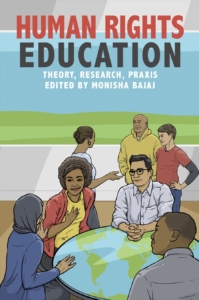
Yeah, I mean, I think the value of using it is very similar to the value of kind of any social justice efforts, right? It allows for people to congregate around this banner of Human Rights Education and address different issues of basic dignity, social justice, critical analysis, but the way that people take up that movement will always be very different. And I think that’s where scholars and practitioners can be in dialogue. I think what’s interesting about Human Rights Education is because it’s a fairly new field, and it’s very grounded in both practice and scholarship. There’s one listserv that is extremely vibrant, that’s coordinated by the US based NGO, Human Rights Education Associates, that started kind of in the late 90s, early 2000s with a few dozen people. When I wrote my book on Human Rights Education in India a few years ago, it was about 8,000 people on the listserv. I’m on this listserv now. I think the latest I looked up its 16,000 people on this listserv from 170 different countries. And it’s an extremely active space for people to share what’s going on, what they’re doing, perspectives, insights, government efforts, feedback on the UN Declaration on Human Rights Education and Training that came out a few years ago. There were several conversations about what should go into that. It’s very rare in other intergovernmental spaces, that you would have such an active civil society participation in the drafting of a declaration or in the discussions about the everyday kind of practice. So, I think being a field that’s relatively new and relatively small, more or less, it allows for this very vibrant and dynamic space where people can contest the definitions or bring in new ideas to it. But it also means that we can’t think it’s all the same. It’s not a monolithic whole. The way individual’s kind of think about Human Rights Education is shaped by where they’re positioned, their social location, what their goals are through the project. And that’s why I think this book is really, you know, it’s meant to be a very introductory textbook on you know, what is Human Rights Education, who’s in the space, what are the different perspectives that exists there and kind of teasing out some of these different conceptual and theoretical perspectives that infuse the way that we think about the field
Will Brehm 25:00
Are there any examples of the outcomes of Human Rights Education? Like, “this is a great outcome of this particular initiative or practice of Human Rights Education”.
Monisha Bajaj 25:14
Yeah, so the area of sort of, I mean, I think research contributes to that. But definitely the area of evaluation is very contested. Because, as with any sort of educational program, it’s difficult to say this is the concrete outcome of this. But there have been studies that look at kind of prejudice reduction, there are three kind of large buckets that Human Rights Education focuses on: So, one is the cognitive. So greater awareness, knowledge about human rights history, standards, norms, maybe they’re domestic rights that everyone has access to. The second bucket would be kind of the affective, attitudinal. So, how does Human Rights Education affect the way that individuals interact with each other? This kind of emotional or attitudinal behavioral area. Is there actually less bullying because Human Rights Education is happening in a school? Is there greater inclusion among different social groups in a school or educative community? And then the third bucket is action-oriented. And that’s one of the trickiest areas to assess because a lot of school children don’t have a lot of time for social action. But Human Rights Education also takes place in a lot of non-formal education learning spaces where there are adult learners, it can happen in community-based spaces, it can happen in after school spaces. So, these are areas that different scholars have looked at. So, what is kind of the content, what are the sort of affective, and what are the action-oriented components that learners -whatever age they are- develop and incorporate into -and even educators- as they learn about Human Rights Education, what are they taking up and doing with this information? I look at that some in my book on Human Rights Education in India. Schooling for Social Change, is the name of that book. Other scholars have also done that, and we have, you know, chapters by about 20 different authors in this new book Human Rights Education: Theory, Research and Praxis, that gives short chapter snippets of what they’re looking at. One of the really interesting chapters that we were excited to include in this book is by Oren Pizmony-Levy and Megan Jensen, where they look at a professional development Human Rights Education program for individuals who work with people who work with refugees who are claiming asylum based on persecution of their gender identity or sexual orientation. So, this was a really important chapter to include because a lot of human rights frameworks, especially the Universal Declaration of Human Rights, doesn’t identify sexual orientation as an area that you have to be free from discrimination of. And as we move from the 1940s forward, more declarations and conventions and international frameworks have incorporated some around sexual orientation, but it is a very sort of contested area when you think about the different nation-states and different laws that criminalize activity. So, this was an important chapter to include and they present some evidence of a training program done by an organization that really does show how individuals who participated, in a quantitative measure, reduce prejudice towards individuals of different sexual orientations through participation in this professional development. So, there are these ways of sort of evaluating. It could be that long term, there are kind of reversals to old ways of thinking, but there are different methodological approaches in the field and some attention towards addressing, “Okay, what are the outcomes and how do we assess these outcomes so that we are moving towards greater respect for human rights through Human Rights Education?”
Will Brehm 28:52
I want to bring the conversation all the way to today when where Marine Le Pen did not win the French presidency, but she came in second and earned more votes than her father did. And in a way she exemplifies this rise of nationalism and ethnocentric thinking -at least in Europe and maybe in the US where Donald Trump won the presidency- and we see this new anti-global talk and discourse and much more nationalistic and I wanted to in your sense: Do you think that this sort of discourse that we see in Europe and in America is going to affect Human Rights Education?
Monisha Bajaj 29:41
So, I see it as not only Europe and America. I mean if we look at the Philippines what’s going on with the leader there. India you know there’s been a tremendous cracking down on descent, revoking of human rights organizations sort of national permission to operate by the Prime Minister there right now. I think it’s a global trend. So, I just want to say that it’s not just the United States and Europe, even though that’s what we get most of the news about. It is really a global trend towards this kind of authoritarianism. In my opinion, it definitely makes Human Rights Education more necessary than ever. So, if you see Human Rights Education as a political and pedagogical project, we need more consciousness raising, critical thinking, critical media literacy, we need it more than ever. And the way I kind of give a quick definition of Human Rights Education sometimes is that space where cosmopolitanism meets Paulo Freire’s ideas. So, I think there’s this beautiful merging of this cosmopolitan thinking, that we are kind of global citizens, that we do have these shared moral, legal, and ethical frameworks which we see in human rights. But that individual consciousness raising has to happen at very local levels with very kind of tailored approaches to the communities that you’re involved in. So how individual communities link to that global, ethical framework and what’s needed to get them to think in perspective, or in relation to that is very different. So that consciousness raising that political, pedagogical, participatory education that happens has to take into account how people are situated in relation to this global. And right now, I think this move towards authoritarianism and this very kind of “rise of nationalism”, is related to a very sophisticated explanation that these kind of charismatic leaders who tend towards authoritarianism are able to give, which is that your economic woes and your hardships are because of “the other”. So particularly with Brexit, there was a very strong propaganda, whatever effort, towards blaming immigrants for the economic hardships when in reality if you take a structural lens on what’s happening is that manufacturing -a lot of the industrial jobs that individuals were in- moved overseas long ago. But the way that the kind of right-wing efforts were able to pin that answer, when people were asking, “Why is my life so hard?”, they were able to pin that answer on individuals who looked different and this kind of rise of multiculturalism through the European Union and migration that had been facilitated to that. When that actually, structurally, was not the reason why people’s lives were harder. It was the collapsing global economy and the rise of neoliberalism and factories moving to where wage labor is the cheapest in places like Bangladesh or Cambodia or Haiti. So, there’s this very sophisticated, I would say political education by the Right to give answers to these kinds of questions that we human rights educators really have to counter with correct and clear analysis that includes critical thinking, critical media literacy, historicizing the situations that individuals find themselves in but I think some of the ways that Human Rights Education operates is so grassroots. It’s very difficult to counter such sophisticated and well-funded campaigns on the other side.
Will Brehm 33:10
Well, Monisha Bajaj, thank you so much for joining FreshEd, it was really great to talk today.
Monisha Bajaj 33:15
Thank you so much for having me.
Have any useful resources related to this show? Please send them to info@freshedpodcast.com