Global Education Policy and the Temporal Dimension
Global Education Policy and the Temporal Dimension

Global Education Policy and the Temporal Dimension
Taking Stock of the Abidjan Principles
Educational Privatization in Brazil and Portugal
The global architecture for aid is mostly contained within the 17 Sustainable Development Goals, which were adopted by the United Nation’s member states in 2015. We’ve discussed goal 4 – the one on education – at length in previous episodes. Today we take a look at goal 17, which aims to “strengthen the means of implementation and revitalize the global partnership for sustainable development.” What is a global partnership for sustainable development? And how does it manifest in education?
With me to discuss goal 17 is Francine Menashy, an Associate Professor in the Department of Leadership in Education at the University of Massachusetts Boston. Her research explores global education policy, international financing of education, and private sector engagement in education.
Francine’s latest book, International Aid to Education: Power Dynamics in an Era of Partnership, provides a critical take on partnerships, arguing that power asymmetries continue to exist.
Citation: Menashy, Francine, interview with Will Brehm, FreshEd, 186, podcast audio, February 10, 2020.https://freshedpodcast.com/francinemenashy2/
Will Brehm 2:47
Francine Menashy, welcome back to FreshEd.
Francine Menashy 2:50
Thank you.
Will Brehm 2:51
So, I want to start with maybe just a context question here. Can you tell me what the Sustainable Development Goal #17 is?
Francine Menashy 3:00
Sure. I am sure most of your listeners are quite aware of the SDGs, which is this huge agenda to address all sorts of economic, social, environmental challenges that are facing humanity. And in particular, most people working in the field of international education know about SDG 4, which is on quality education. But the SDG goal that I think we should be paying a bit more attention to is the last of all the goals, and that’s #17, and it’s on partnership, or as its termed “partnership for the goals.” So, this goal, and the way that it’s framed in the UN SDG declaration, actually acts as the foundation for all the rest of the goals by advocating for increased partnership in order to achieve the whole SDG agenda. So, the other 16 goals.
Will Brehm 4:04
So, basically, SDG 17 is saying that we need partnerships to achieve goal 1, 2, 3, 4, 5, 6, 7, 8…all the way to goal 16. Is that?
Francine Menashy 4:12
Exactly!
Will Brehm 4:13
Partnerships are somehow the most important thing, or a valuable tool, to achieve these goals.
Francine Menashy 4:20
Yes. So, it is framed as this need for global solidarity between all different actors -the state, the non-state sector, the global North, the global South- nobody can achieve the SDGs on their own. We need to work together in partnership with one another. So, in many ways, the SDG agenda is considered dependent on partnership on achieving SDG 17.
Will Brehm 4:45
So, how do we even begin to understand what the idea of partnership is? I mean, I am just thinking here, there’s so many different definitions of what a partnership could be, you know. My wife and I are in a partnership, I am a partner in the structures of FreshEd, you know, I have a partnership with my university in the IoE in London. So, you know, how do we even begin to understand what a partnership even means?
Francine Menashy 5:11
Yeah, I mean, when I say the word partnership, a lot of different definitions pop into my head, too. And I am sure everyone listening has an idea of what a partner is. And it probably brings about pretty positive associations, right. But in trying to define it, it is actually a pretty ambiguous term. And this has meant that in international development and in international aid, people and organizations have taken it up and used it in all sorts of ways. So, for instance, a partnership might be defined as something really practical, like just working together to reach common aims. And in international aid, it often means coordination between actors, or collaboration, or building coalitions, but in this sense, partnerships are for practical reasons. It is very instrumentalist to achieve particular aims and more effective practices.
Will Brehm 6:15
So, that is how they are implied in the SDGs, but you know, are there other ways to think about partnerships that you know, maybe people in development aspire to?
Francine Menashy 6:24
Sure. And even in the SDGs, it goes beyond that. So, partnerships are also defined in the development arena through a more ethical or a more normative lens. So, most often, this is in reference to those on the receiving end of aid. So, local communities, beneficiaries, people in the global South, and how they need to be viewed as partners as well. Because not only would this lead to more effective development practices, but also because inclusion and participation is the right thing to do -that recipients of aid shouldn’t be excluded from the processes that directly affect them. And then finally, this term partnership is often also conflated with this notion of public-private partnership. So, many organizations and people in the development arena argue that the private sector -and you know, I will admit the private sector is huge. It is really anything non-state, but I’m speaking mainly about businesses and foundations- that they must be partners in all of this as well. And so, and even within the SDGs and SDG 17, there is a lot of discussion around public-private partnership. And so, some organizations use this term partnership interchangeably with PPPs with public-private. So, partnership is a huge, vague term that actually has multiple definitions. And over the past decade, especially, it’s become a real buzzword in international aid.
Will Brehm 7:57
Yeah. So, it seems like there is a conflation of different meanings of partnership sort of into one, which maybe is a good thing somehow, maybe it is a bad thing. What do we know about the history of this sort of partnership-based mandate in the aid and development structures that you know, such as the SDGs that we started with?
Francine Menashy 8:21
So, I would trace the real start of this partnership-based mandate to around the late 1990s. So, the 1990s were a pretty interesting time -well, I think they were an interesting time- when the international aid community was going through sort of an identity crisis. So, first of all, you have the end of the Cold War. And during the Cold War period, motivations for development aid were pretty clear cut. Rich country, capitalist governments largely saw international aid, as a way to get the support of post-colonial countries while also promoting democracy and capitalism. So, this was essentially buying allies in the Cold War. But then, with the end of the Cold War, capitalist countries no longer needed to build these strategic alliances or any kind of strategic advantage through aid. Secondly, the development practices and the policies of these capitalist economies, and also multilateral agencies, were very market-based. I mean, some would argue that they’re still very market-based, but then they were largely promoting structural adjustment, which, and especially in education, came under intense scrutiny by the mid-90s when critics really came down hard on structural adjustment programs, they’re widely considered ineffective, they hadn’t spurred substantial economic growth, and they had severe impact on social services, exacerbating all sorts of inequities. And so, by the mid-90s, public perception of aid was that it simply didn’t work. It actually sometimes did harm. And this led to really tempered public support and reduced aid budgets overall, it was a really pessimistic mood. So, this combination of this vacuum in purpose left by the end of the Cold War, and then all this rising criticism of the ethical impacts of all these market-based development policies, it left the aid world in kind of a crisis state, and they were in search of a remedy. And so, a new framing of international aid was needed, that would provide a clear purpose and lend a new legitimacy to aid. And this new framing, or this new narrative, became this notion of partnership. And it was actually an explicit decision that was made by members of the OECD DAC to change the narrative. They wrote a report on this new agenda and development cooperation, and it was also codified in the Paris Declaration on Aid Effectiveness, which was adopted in 2005. So, partnership became the new aid narrative.
Will Brehm 11:10
So, there’s these very clear actors who wanted to, as you said, rewrite the narrative on aid in this sort of post-Cold War moment, or not even post-Cold War, I should say, sort of post-Soviet Union. The end of the Cold War, we have to think about how does aid fit into development around the world. And so, you know, what did -these particular actors that were trying to rewrite the narrative- what did they see the purposes of partnerships as being?
Francine Menashy 11:42
Well, they thought it would be a narrative that could be sold really well to all of those who’ve been critiquing the aid environment over the course of the 80s and the 90s. So, I mean, although this partnership narrative was taken up as a mandate, because new actors agreed that collaboration and coordination, and that sort of thing was needed, the real value of partnership as a development mandate, I think, really rested on this idea of North-South partnership. So, the critiques of development aid that I was just talking about, at that point, were really focused on structural adjustment and on this unethical, top-down nature of aid, and how donors and multilateral organizations from the global North just drove development policies and practices. It was a near completely non-participatory environment. And this was seen as wrong and unethical. But partnership meant that power asymmetries between actors and organizations in the global North and the global South could be reversed, in a sense with recipient countries now considered partners, who not only participated in the design of development programs, but owned them. So, this concept of “country ownership” became core to so many aid policies. So, through North-South partnership, with more country ownership, with more local participation, there would be a change in power relations.
Will Brehm 13:15
It just makes me think, so this is the 1990s, it is like 30 years on from then, how did it go? You know, did the power imbalances change?
Francine Menashy 13:24
So, the partnerships that I have studied and also, I mean, I make this assessment based on all of the, you know, research that I’ve read from other fields, from development studies, from those who have studied partnerships in health and in the environment and in other areas, as they’re currently designed, it appears that partnerships don’t really shift power asymmetries. In fact, sometimes partnerships exacerbate inequities. And this is because although the narrative changed the structure of international aid, the systems, or the architecture of aid, and by that I mean, the system, and the relationships, and the mechanics through which decisions are made on aid and how it’s delivered, and the people and the organizations who really drive the policies and the processes have remained the same. Those in power are still those from the global North. And those who I mean, to put it really bluntly, those who have money, those who have resources.
Will Brehm 14:30
Right. So, the discourse perhaps has changed, but the underlying power structures have not.
Francine Menashy 14:36
Yeah. And even the organizations have changed, and the activities they engage in have changed. But the structure of international aid has really fundamentally remained the same.
Will Brehm 14:50
So, let’s look at a couple examples to sort of explore what that actually means, where things have stayed the same even if some superficial changes have taken place. So, one of the big actors in development today is the Global Partnership for Education. It literally has partnership in its name. Can you tell us a little bit about, we call it, the GPE? What is the GPE? And how does it sort of operationalize the idea of partnerships?
Francine Menashy 15:21
Yeah, I mean, first of all, I wouldn’t call these changes so much “superficial” because I mean, the partnership mandate actually spurred the design of a new form of organization. And that’s pretty big. And they are called multi-stakeholder partnerships, or MSPs. And I should first explain that these multi-stakeholder partnerships are everywhere. They are not just in education, they’re in development more generally in all different sectors, and they’re these organizational manifestations of this partnership narrative. So, multi-stakeholder partnerships, they tackle single-issue areas like health or the environment or, as in the case of GPE, education. And they bring together stakeholders from the state and the non-state sectors from the global North and the global South into single decision-making forums where they can collaborate and coordinate policies on development funding, they pool aid. And GPE is a multi-stakeholder partnership dedicated to increasing quality education worldwide, and they support low-income countries. And GPE was initially launched in 2002 by the World Bank, and it was called the Education for All Fast Track Initiative. But it’s since been rebranded into GPE. It’s been GPE for quite some time, and it operationalizes this idea of partnerships through both its country operations and its governance. So, its governing body is rhetorically defined as an equal partnership. It is a constituency-based board. It consists of voting members that represent donor countries or bilateral aid agencies, recipient countries, multilateral agencies, civil society, from the North and the South, private sector foundations, and includes over 70 developing country partners -that’s what GPE terms them DCPs- that receive resources via this GPE Fund, which is this pooled fund, and it’s financed predominantly by high-income, Northern donor country partners or bilateral donors. And its first guiding principle in its charter is country ownership. So, it is an organization, it really attempting to embody this idea of recipient countries on equal footing with those in the global North.
Will Brehm 17:57
And has it lived up to such a value?
Francine Menashy 17:59
In my research -and this includes many interviews with stakeholders and analysis of many different kinds of documents- I studied GPE’s history of reforms, its governance dynamics, its country-level processes and I found that despite real efforts, like real explicit efforts, GPE tends to retain a power dynamic that’s akin to that of this traditional aid architecture in which actors who are situated in the global North wield the most influence and have the most dominant voices in decision making. So, just as an example, the World Bank, which initiated GPE back when it was the Fast Track Initiative, it acts as its host, the GPE offices are within World Bank headquarters, and it is GPE’s most common grant agent, which means it distributes funds at the country level. And according to many of my interview respondents, the World Bank is viewed as having just an outsized level of influence on the partnership. As well, representatives of high-income donor governments were widely viewed as having the most dominant voice and influence within GPE governance based on my interviews, and it’s no coincidence that they’re the ones that are financing GPE. So, in this case, resources, or money, equals influence in many ways. I also found that those who speak dominant languages, mainly English and French, also had more influence, which naturally exclude so many representatives from many countries in the global South. And I also saw that country-level operations, despite engaging local education groups and local actors, were, in fact, very donor and multilateral dominated as well. But I do want to add that GPE as an organization, its members, its Secretariat; they’ve made huge strides and numerous explicit efforts to ensure that its developing country partners have more voice and have more influence. They’ve started having these pre-board meetings for Southern constituencies; the Secretariat gives them a lot of support to engage. So, these are more recent efforts that I’m hopeful will make some difference, but at the time of my research, these North-South power asymmetries were pretty stark.
Will Brehm 20:38
It’s quite interesting, I mean, because you can, you know, design a whole organization to sort of embrace that 1990s idea of partnership and, you know, have constituencies on the board and have DCPs trying to be represented and try and have a bit more equality between the North and the South, so to speak and yet, you’re saying, we still see sort of power imbalances reemerging along very familiar lines -language, money, particular institutions that are powerful globally and have been for quite some time. And it just makes me wonder, you know, even if we had the best design structure, are we always going to be running into some of these larger problems? Like in other words, is it actually a function of the nation-state being sort of problematic and therefore having power imbalances among and between nations, and so creating structures that are multi-stakeholder partnerships where the nation-state is, you know, one of the main actors, that these problems that you’ve identified are sort of always going to emerge out of it?
Francine Menashy 22:01
That’s a great question. It is entirely possible, but my only hesitation with thinking that that’s at the root of the problem is because these multi-stakeholder partnerships are also highly inclusive of private sector actors and non-state-based actors, civil society actors. And what I also observed is that those power dynamics, the issue is not with the nation-states so much, the issue is with the global North and having money and being from high-income countries. That is where I see this issue hinging. Less so about the issue of the nation-state.
Will Brehm 22:48
Right. So, it could be more about, in a sense, global capitalism, and you know, big multinational organizations or companies finding new ways to extract profit. And for whatever reason, they’re deciding to get into these multi-stakeholder partnerships; they still have their bottom line as being the driving force.
Francine Menashy 23:09
Absolutely. Yeah. And that would be most notable when we are discussing the private sector. But I think this has much more to do with the capitalist and unequal -as a result of being capitalist- unequal economic structure of the world economy. It’s less about the nation-states and more about economic structures, in my view.
Will Brehm 23:37
Yeah. Right. It’s interesting because then it just makes me think, you know, how can you then create any organization and structure in, you know, these sort of idealistic, ethical, sort of you know, want to change power imbalances but if you don’t actually address some of these deeply unequal economic structures, we’re going to basically replicate the same power imbalances that we originally were trying to solve. I mean, it’s a bit, I don’t know, depressing.
Francine Menashy 24:07
It is! I mean, the economic system and our structures are so fundamentally flawed and so destined to rely on these power imbalances in some ways. It is depressing, but I’m hopeful for change.
Will Brehm 24:25
I mean, that is interesting as well. That the power imbalances are actually a needed feature in the system. And, you know, therefore, it’s almost impossible to overcome them. But I want to turn to maybe not as big of an organization as GPE, but a slightly different type of organization that also is thinking about partnerships in new ways. And I want to talk through that. And this is the organization called Education Cannot Wait or it is a fund, I think, and you sort of detail this in your book as well. Can you just give us an idea of, you know, what is Education Cannot Wait, and how does it sort of understand and operationalize the idea of partnerships?
Francine Menashy 25:09
Sure. So, Education Cannot Wait is a partnership with a mandate to fund education in emergency contexts, which are contexts that have been historically underfunded. And it’s fairly widely agreed now that the traditional aid mechanisms have not been adequate to address education in sudden emergencies and in contexts of fragility. So, Education Cannot Wait was envisioned as a faster, a more agile, a less bureaucratic organization that can respond rapidly to support education in contexts of crisis. So, it was largely spearheaded by Gordon Brown, who’s the UN Special Envoy for global education. ECW is governed by what’s called a high-level steering group, but it’s actually very much like the GPE board. It’s also constituency-based, and it operationalizes this idea of partnership, and in a similar way to GPE, through its decision-making process. It has governments of conflict-affected countries represented in this high-level steering group; it has representatives from the state and the non-state sector. And it also promotes in its policy discourse, and its organizational rhetoric, this idea of national ownership. And it promotes what it calls a localization agenda. And this means the participation of local communities, affected communities in its governance and in its country-level processes. And it’s only been around since 2016.
Will Brehm 26:57
Do you think it is, you know, living up to this idea of partnership by creating, you know, less Northern driven aid, more local participation, changing power imbalances, you know, how do you read what ECW has been doing for the last three or four years?
Francine Menashy 27:16
So, based on my research, including interviews that I’ve conducted, quite interestingly, because I conducted the ECW research after the GPE research, but many of the critiques of GPE were really paralleled in my findings. So, just as the World Bank hosts GPE, UNICEF hosts Education Cannot Wait. And respondents in interviews repeatedly identified UNICEF as holding an outside influence and being a real central player. As well, in its governing body, high-level actors and organizations from the global North hold the most vocal positions, while beneficiaries, including local governments, and communities that are affected by crisis -refugee communities, for instance- have participated in only a fairly limited way. And in its country level work, I was told that organizations and actors from the global North -including not only donors and multilateral agencies, but also international nongovernmental organizations, so the big global NGOs- really control the Education Cannot Wait fund implementation process, with very little input from local actors. So, I should add, though, as I mentioned, ECW is a very young partnership. It’s only been around for a few years, and all the people who I spoke, I was going to say most of the people, but all the people that I spoke with, recognize this as a problem, and they want to make changes. But as it stands, there are still these clear North-South power asymmetries with ECW.
Will Brehm 28:56
It’s interesting. So, I mean, this is sort of like organizational studies in a way, right? How do you have an organization where everyone potentially inside sees that this is a problem, and they want to make change, but then still cannot make change? Right? How is the organization somehow larger, and has a life of its own, that’s preventing all of these individuals who share the same idea from enacting the change they want to see?
Francine Menashy 29:21
You know, that’s such an interesting point, because I’ve actually been in search for a name for this phenomenon of an individual recognizing the problem and individuals within an organization, all of them recognizing that this is an issue, and not so much even the inability or the incapacity to change it but it’s almost as though the institution itself won’t permit the change. And so I’d be really curious if any of your listeners have a name for it in organizational theory perhaps, for this phenomenon, because I find it so fascinating, because I can safely say that I interviewed so many people from within these organizations that partner with them and believe in them and recognize this as a fundamental problem and yet, these power asymmetries continue.
Will Brehm 30:24
And, are private actors involved in ECW, like they are in the GPE?
Francine Menashy 30:29
They are. They’re involved in both of these multi-stakeholder partnerships. And by this, again, I am speaking mainly about companies and foundations, and in Education Cannot Wait rhetoric, they’re really strongly embraced. So, the Global Business Coalition for Education, for instance, has been involved, since the start. Actually, a core impetus behind the establishment of Education Cannot Wait was to engage the private sector and leverage private actors as what’s termed non-traditional funders to education in emergencies. So, they’ve been invited into the Education Cannot Wait fund and partnership largely because of their resources. In my analysis of the discourse around Education Cannot Wait, private actors are framed in a very aspirational and positive way. A lot of language around efficiency, technical expertise, having huge resources, advocacy power, they’re a new form of financing. So, it’s all very exciting, creativity, innovation. And I should add that a very similar discourse comes out of GPE, too. And this discourse, I think, drives perceptions of private actors as legitimate partners. And it leads to their authority in decision making spaces. So, private actors, including both foundations and companies, sit on the governing bodies and the decision-making spaces of both Education Cannot Wait and the Global Partnership, but what I actually found is that the private sector hasn’t made much of a financial commitment to either of these partnerships. But they have this key powerful role in governance. So, they have what’s termed, and this is a term I do know, “private authority,” which refers to the growing role of non-state based actors, most notably those affiliated with businesses in public policymaking spaces such as education. And I’d say that this role of private actors also perpetuates; it comes back to this North-South power hierarchy because the vast majority of private partners are situated in the global North, or headquartered in the global North, be it in California or New York, or London, or in other high-income countries and they’re primarily involved from my understanding because they have resources.
Will Brehm 33:09
But yet they’re not giving the resources is what you’re saying.
Francine Menashy 33:12
Yes.
Will Brehm 33:13
Right. So, GPE is inviting them in, or ECW is inviting them in, giving them a spot on the board because they have resources and then the private actors in return don’t actually -they’re not contributing to the common pool of funds.
Francine Menashy 33:25
That’s right. Or to a very small degree. And the reason that I was giving and asking directly to these private actors, to foundations, to company representatives, was they don’t feel comfortable putting their funds into a pool of money where they can’t track it. They can’t follow the money; they can’t track their investments, which I mean, I guess it’s a fair statement to make. They want to know where their money is going and whether or not it’s having an impact, and that’s not something that’s possible when it’s pooled with other funds.
Will Brehm 34:02
So, I wonder why do they then even accept the board seat?
Francine Menashy 34:06
Well, I think they want to have a voice and have some type of power in decision making. They want to have an ear to the ground on what’s happening. It’s a question that I don’t really have a firm answer to. And I should say my answer was kind of skeptical because they also say because they care. Because they care about humanitarianism, they care about education in emergency context, they care about education in development, and they want to be there because they believe they have the expertise, they believe they have the technical know-how, that they can really give something to these partnerships above and beyond resources.
Will Brehm 34:52
It’s a very fascinating ethnographic insight into some of these boards that are made up of such different stakeholders and trying to understand why they might participate in such an endeavor. So, you know, in the end here, we have a situation where we have, you know, new aid architecture forming since the 1990s around the idea of partnerships and yet, you know, in the end, we’re still seeing a lot of these power imbalances continue, even though we have some new aid architecture. In your research, did you find any sort of examples or things that you can point to, to say, that’s a particular strategy that seems like it would be valuable to explore, to create a bit more power equality?
Francine Menashy 35:40
Yeah. I mean, despite all of these critiques of partnerships, I believe, and this is based on not just my own thinking but also the views of many of these interview respondents that I spoke with that multi-stakeholder partnerships are a move in the right direction, and they do have potential to shift power imbalances. But it’s a real challenge -what they’re up against. One way, I think, to make this shift happen is to be very intentional about eliciting active participation of stakeholders from the global South. And what I found is that partnerships have a tendency to elicit what I describe as symbolic participation, which is when actors are included physically in a space, and they’re touted by an organization as partners based on their seats at the table, but they wield very little influence, and they’re positioned as the least dominant voices in decision-making. So, one of the respondents in the study told me, and I always remember this quote, “the whole starting point needs to be different.” The starting point needs to be with the recipients of aid. The starting point can’t be with a bilateral donor, a multilateral organization; it can’t be with UNICEF or the World Bank. It can’t be with a company in Silicon Valley. It has to be with those who are receiving the aid. They’re the ones that need to get the ball rolling, make the decisions. And also, this idea of active participation, especially at the country levels, requires trust in local partners. Yet this trust appears to be quite rare. It requires that Northern actors relinquish control over development processes. And I found that bilateral donors, in particular, seemed very resistant to relinquishing control. But if I had that opportunity, I would be more explicit about the fact that power relates so strongly to privilege. And there is a lot of conversation around this notion of privilege, especially in the United States, where I work around, you know, white privilege and male privilege and the need to recognize it. So, I’d say that actors from the global North, who engage in these partnerships, they need to recognize their own economic, social, and more often than not racial privilege. It’s not discussed nearly enough, I think, in comparative education. But these hierarchies we’re talking about, they’re near always racialized. But more important than just recognizing privilege, it’s being willing to give that privilege up. To either use less of your own voice, to keep quiet, to defer to others, or to possibly step down and off of these policy bodies to make space for representatives from local communities or recipient countries. So, I think that would make real structural change and begin the process of shifting these power dynamics in international aid.
Will Brehm 39:01
Well, Francine Menashy, thank you so much for joining FreshEd again. It really was a pleasure of talking.
Francine Menashy 39:06
Thank you.
Today we air the first ever FreshEd Live event, which was recorded last night in San Francisco. Gita Steiner-Khamsi joined me to discuss the ways in which the global education industry has altered the State and notions of free public education.
We touched on a range of topics, from Bridge International to theInternational Baccalaureate and from network governance to system theory. Gita theorized why the State has taken on the logic of business and how a quantum leap in privatization has radically altered education.
Gita Steiner-Khamsi is permanent faculty at Teachers College, Columbia University. In addition, she has been seconded by the Graduate Institute of International and Development Studies in Geneva as a faculty member and by NORRAG as the director.
This FreshEd Live event was sponsored by NORRAG.
Citation: Steiner-Khamsi, Gita, interview with Will Brehm, FreshEd, 150, podcast audio, April 15, 2019. https://www.freshedpodcast.com/gitalive/
Transcript, Translation, Photos, Resources:
We hear about educational privatization a lot these days. My Twitter feed is filled with countless stories about how Betsy DeVos is going to privatize education in America or how Bridge International has privatized education in some African countries. Even the first three episodes of FreshEd way back in 2015 looked at how privatization has gone global.
But do you really know how it’s happening, how privatization as an educational policy is moving around the world? And what effect is it having on governments?
The process of national and local governments enacting policies that advance private interests in education is rather complex and often opaque to the general public. My guest today, Stephen Ball, has written a series of books looking at educational privatization. In his latest book, Edu.net, co-written with Caroline Junemann and Diego Santori, he explores through network ethnography the evolution of the global education policy community that is advancing privatization.
Stephen Ball is a Distinguished Service Professor at the Institute of Education, University College London.
Citation: Ball, Stephen, interview with Will Brehm, FreshEd, 78, podcast audio, June 19, 2017. https://www.freshedpodcast.com/stephenball/
Transcript, translation, and resources: Read more
Low-fee private schools are a hot topic in educational research. What happens when public schooling is provided by for-profit companies that charge families monthly user fees? What happens when those companies receive government funds? Researchers around the world have been exploring various issues around for-profit public schooling.
One company has been of particular interest. Bridge International Academies operates schools in Africa and Asia and is supported by people such as Bill Gates and Mark Zukerburg. Bridge International uses a standard curriculum that is read off of a tablet computer. This low-cost model of schooling relies on paying small wages to instructors, who simply read the curriculum, and fees paid by students to attend (or government subsidies). This type of schooling can be extremely profitable when delivered to scale. In the most extreme case, in Liberia, the Ministry of education is trying to outsource its entire primary education system to Bridge International.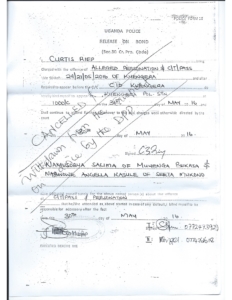
Given Bridge international’s work, it’s no wonder that researchers are interested in exploring what’s happening at the policy level and at the school level when it comes to low-fee private schools.
In May this year, Canadian Researcher Curtis Riep was in Uganda researching Bridge International’s work. At one of his meetings, held at a local café, he was arrested for impersonation and criminal trespass
ing while collecting data. These charges were later proven to be baseless and he was released and not charged (see image on right).
The interesting thing, however, is that Bridge International seems to have played a role in Curtis’ arrest. Before he was arrested, for instance, Bridge International took out a public notice in New Vision, a local newspaper (see image below), warning the general public of Dr. Riep’s presence.
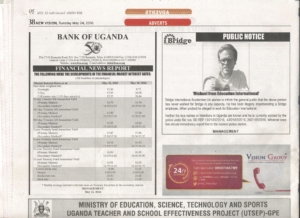
My guest today takes us through this odd case and explores the larger issues around Bridge International. Angelo Gavrielatos is a project director at Education International, the Global federation of teacher unions and the organization that funded Curtis Riep’s research.
After recording the show with Angelo, new developments unfolded in Uganda. Below the fold, you can read the latest updates.
The Ugandan ministry of education has recently closed many schools that did not meet minimum standards, including schools operated by Bridge International. Although the connection between Curtis Riep’s research and the recent closures are unknown, these events suggest Curtis was likely on to something important:
Bridge International Academies appears to be losing its foothold in Uganda following a government decision to close 87 for-profit primary schools, including those belonging to Bridge, after failing to comply with minimum standards and regulations. (Link)
UPATE: The research Curtis was working on has finally been published. From Education International’s (EI’s) press release:
EI’s analysis of Bridge’s curriculum and pedagogy reveals serious implications for teachers and students that fundamentally alters the nature and practice of education itself. The company has created a business plan based on strict standardisations, automated technology, cheap school structures, and internet-enabled devices that are used to carry out all instructional and non-instructional activities that make up an education system.
You can download the full report here.
Citation: Gavrielatos, Angelo, interview with Will Brehm, FreshEd, 36, podcast audio, August 8, 2016. https://www.freshedpodcast.com/angelogavrielatos/
Will Brehm 2:03
Angelo Gavrielatos, welcome to FreshEd.
Angelo Gavrielatos 2:10
Welcome. Thank you.
Will Brehm 2:12
So Curtis Riep is a researcher at the University of Alberta and he was arrested for impersonation and criminal trespassing while collecting data there. Why was Curtis in Uganda?
Angelo Gavrielatos 2:27
Curtis Riep is a scholar from the University of Alberta and during the month of June and just prior to June, he was in Uganda researching on behalf of Education Interational, the global union federation of teachers. And his research was focusing on the operations of Bridge International Academies in that country. Curtis is a highly regarded, highly respected scholar, had been conducting research into privatization of education in Ghana, in the Philippines and elsewhere. A highly regarded young scholar.
Will Brehm 3:07
As a researcher myself, it’s a huge fear that I have of going to a country and asking sensitive questions and then getting in trouble for that. Can you describe how or why Curtis Riep was arrested?
Angelo Gavrielatos 3:25
Well, I can describe to you how he was arrested. Why he was arrested, one can only speculate because clearly the allegations that were made by Bridge International Academy have been found to be, and proven to be, false and without substance. So the question with respect to why he was arrested we’ll come back to shortly. But in terms of how he was arrested, one morning, he was meeting with senior officials from Bridge International Academies in Kampala at a coffee shop, and during their meeting, they obviously tipped off the police who proceeded to that venue to apprehend Curtis on the basis of charges that they’d made. Prior to these allegations that had been made by Bridge International Academies, they had also bought space in a national newspaper and printed what we would describe as a wanted photo with Curtis’ photo on it alleging impersonation and criminal trespass, saying that he was wanted by the police. Now this is an extremely irresponsible set of actions on the part of this company. And one can conclude, to come back to your first question, why he was arrested, one can conclude that this company is very clear in its intent of wishing to stop any scrutiny, any external scrutiny, of its operations which have come under considerable criticism by scholars across the globe. And I’m talking about their operations of course in Kenya and elsewhere.
Will Brehm 5:11
And we’ll get into that, what they actually do, in a second. But first, it’s just amazing to think that the police and Bridge International have such a close relationship that Bridge International could simply call on them to arrest someone that quickly.
Angelo Gavrielatos 5:31
Well, I am not going to go into the relationship that may or may not exist between Bridge and the police. But what we can say is that they made certain allegations. Allegations which have been shown to be false without substance. But that didn’t stop a young researcher having been arrested, and I would say terrorized and traumatized by that process whilst going about his business as a researcher. It is important to note that prior to visiting any school, Curtis has stated that he tried to make contact with the academy manager to alert them to the fact that he was visiting, and where that wasn’t possible, he reported to the front office of schools to announce his arrival and request access to the premises. To thereafter find yourself the subject of a wanted poster, and to find yourself arrested on allegations, which I repeat, were shown to be without substance – they were dismissed following investigation by the police and the public prosecutor. To have found yourself having been arrested and to be driven to a police station some 90 minutes from where you were arrested, having passed two or three police stations along the way, is quite traumatic. I think it is also important to note that upon his arrival at that police station, there were news crews, media crews awaiting his arrival. Clearly, one could only suspect having been tipped off by Bridge National Academies in order to try to get some mileage out of this very, very ugly episode.
Will Brehm 7:33
It seems like it was planned, right? Because the police came pretty much soon thereafter he entered the cafe to have his meeting and his research meeting. From my understanding, the lawyer for Bridge International was sitting in the police car when he was arrested.
Angelo Gavrielatos 7:53
That is correct.
Will Brehm 7:54
And then like you said, these reporters were at the police station when he arrived some 90 minutes later. It just seems like there was such a high level of organization to target Curtis Riep.
Angelo Gavrielatos 8:10
Well, if anyone would conclude that this was set up, their conclusion would be very much within the realm of high possibility. You know, these things just don’t happen. The fact that you said that their lawyer was in the same police car is just outrageous. But I’ll say this, if Bridge International Academies thought that they were going to get some political mileage out of what they do, they’ve made a very big mistake. They have been roundly condemned by scholars, academics, researchers, every serious education commentator in the world is just shocked and appalled by what they’ve done.
Will Brehm 9:01
Do you know what Curtis was researching specifically that that you know made Bridge so nervous?
Angelo Gavrielatos 9:08
Well, Curtis was researching Bridge’s operations in Uganda. He was looking at all aspects of their operation. He was also investigating why it is that the Ugandan authorities had stopped, had suspended any further expansion of Bridge’s operations in Uganda. I think it is important to note that this company has very little regard for the nation state and national laws, and they seek to operate in ways that are not entirely consistent with national requirements with respect to the provision either looking for loopholes, seeking to exploit loopholes, or seeking to have the government bend in terms of their operations. For example, in Kenya – and this is because their business plan is predicated upon this – in Kenya, they seek to register themselves as “informal schools”, so that the requirements applicable to schools are not as stringent; the bar is set lower. But they are for all intents and purposes schools. So what they do is they operate on a basis where they don’t meet requirements with respect to the employment of qualified teachers. In fact, in Kenya, they employ high school graduates and have resisted, have lobbied strongly and strenuously and persistently against the government, which has sought to impose requirements such as guaranteeing at least that half of its employees are qualified teachers.
They do not follow the national curriculum, and in fact, in Kenya, the head of the Curriculum Authority said that they don’t recognize their curriculum. And other such, and there are other such examples where they fail to operate consistent with guidelines. In Uganda, for example, the reason why their operation has been suspended is because they don’t observe the law in terms of the employment of teachers, nor in terms of appropriate learning facilities. Again, what we’re seeing here is a company that’s operating in such a way to satisfy its business interest, employing unqualified staff delivering a curriculum that’s not consistent with national standards, and often facilities that are not conducive to a school of teaching and learning, and do not satisfy national standards. So Curtis was investigating all of those things, and they clearly don’t want the spotlight put on them.
Will Brehm 11:47
Why do you think a government like Uganda would contract Bridge International Services after you articulated so many of the issues that Curtis was researching?
Angelo Gavrielatos 12:01
Well, I’m not privy to the full history, nor the terms that saw Bridge initially enter into Uganda, and I certainly await Curtis’ report as no doubt you do and many of your listeners. But what we do know is that Bridge started to operate in such a way that was inconsistent with the terms that had been determined, and hence the government suspended any further expansion on their part, the part of Bridge, subject to certain reviews of their operations, not least of which go to questions of meeting minimum standards. So we eagerly await to see the report, what the findings are there. And we certainly hope that the government maintains where it already has existing legislative requirements. And where it doesn’t, strengthen legislative requirements to ensure the social contract that exists between governments and students is not broken. And by that social contract, what I mean is that governments have apart from a political obligation, a moral obligation.
Governments for good reason compel children to go to school; we support that. But having compelled children to go school, that brings with it a political and moral obligation. And given that political moral obligation, we insist the governments ensure that when it comes to the provision of schooling, non-state actors must adhere to certain minimum requirements. Those minimum requirements, which go to the questions of the employment of qualified teachers. Those minimum standards, which go to the condition of ensuring that the curriculum delivered, is consistent with national standards. Legislative requirements, which go to the question of schooling facilities to ensure that those facilities meet minimum national standards. We would certainly hope the government applies those standards that are already in existence properly, enforces them, and where they need to be strengthened, they should be strengthened, because ultimately we are talking about the well-being of children.
Will Brehm 14:17
What sort of fallout has happened since Curtis was arrested, and then found not guilty of any of these charges? In Uganda, what has happened? You said that a lot of people have condemned what Bridge has done, but has there been any more substantial outcomes from this case?
Angelo Gavrielatos 14:38
Well, I know that this matter received considerable media attention in Uganda, as it did internationally. There was some very, very serious and large media interest around the world. That media interest, both internationally and domestically in Uganda, has generated some further discussions. To the best of my knowledge, the government has not altered its position with respect to halting the further expansion of Bridge in Uganda. We believe that the Bridge authorities have been desperately lobbying the government ever since that suspension was put in place. I’m not aware of any further developments there, but certainly, as the Global Union Federation of Teachers Education International together with our national member organization in Uganda – UNATU as it’s called – we will continue to advocate strongly in the interest of students, our members, our teachers, and education workers in the communities we serve. And will continue to advocate that in Uganda and elsewhere, governments must fulfill their primary obligation to properly and adequately fund quality public education, free quality public education for all to include within any legislative framework guarantees that go to the questions of access and equity; issues that go to the question of the respect to the profession in terms of professional judgment, But also we will advocate strongly for the existence and enforcement of a strong legislative framework and minimum requirements for the provision of education. Surely, every child, regardless of background, regardless of who they are, or where they are, regardless of their wealth. Surely, every child’s entitled to be taught by a qualified teacher delivering an engaging curriculum in a safe environment. We will continue to advocate for the achievement of such measures.
Will Brehm 16:40
Do you think if Curtis Riep was not affiliated with Education International, that he would have gone through this ordeal?
Angelo Gavrielatos 16:48
I don’t think we’ll ever know the answer to that question. Can I say this? When we learnt of what was occurring in in Uganda, in Kampala, can I just say to you that we did everything within our power to make sure that Curtis was dealt with, appropriately, expeditiously. And we certainly did everything we could to get him back home safe, back to his loved ones. This was an awful ordeal. Whether he was targeted because of his affiliation with Education International – and by way of his affiliation, he is an independent researcher who was commissioned by EI to do some work. Whether he was targeted for that reason or not, we won’t know, but what I do know is that this has affected him and I certainly hope – and we’re doing everything we can to help him deal with what was an awful set of circumstances. And again, I’ve got to say, the actions of Bridge which have been shown to be without foundation; their actions to print wanted posters or advertisements printed, to call the police to try, and to try and influence the judicial and criminal process in the way that they tried to influence it by taking out that wanted poster, this is mostly irresponsible, and certainly not the behavior becoming of any organization that purports to have the interest of children education at hand.
Will Brehm 18:29
I’d like to just zoom out a little bit here away from this one incident of Curtis Riep being arrested on false pretenses to look at Bridge International kind of globally, because you said they do work in Kenya and they obviously work in Uganda. What other countries are they working in?
Angelo Gavrielatos 18:52
Well, again, let’s start off by saying who Bridge is. Bridge International Academies is a global entity with some very powerful backers. They’re supported by the large global edu business Pearson, the largest global education corporation in the world; they’re supported by billionaires Zuckerberg and Gates, and their foundations; they’re supported by other foundations; they’re supported by the World Bank; and they’re supported by the United Kingdom’s Department for International Development, the aid wing. So they’ve got some very, very strong, influential backers. But ultimately, this is a company that is driven by the profit motive, a company that sets out to make profit. And we believe that when it comes to education, and the provision of education and schooling in particular, the profit motive has no place in dictating what is taught, how it’s taught, how it’s assessed, nor how our schools are organized.
Because in that world, the first victims are students, their teachers, and the communities we serve. Their business plan, when you examine their business plan, and we don’t have much time for me to go in great detail. But their business plan is predicated upon the employment of either fewer teachers, under qualified teachers, or in the main unqualified staff paid at a fraction of the rate of a teacher. On average around the world, plus or minus 5% or thereabouts, about 70 odd percent of a school budget is teacher salary. So you want to make profit, you would basically undercut the provision of teachers or qualified teachers. That’s their first way of making profit. They then go on to make profit through economies of scale. Their product is highly standardized. These high school graduates are not equipped to deliver a lesson as would be a qualified teacher. So what they do is they have all the curriculum material downloaded onto a tablet. And these high school graduates read off that tablet word for word. This is a highly scripted, standardized curriculum developed some where far away, which shows very little regard for cultural and linguistic diversity, let alone respect. But it’s a standardized product read word for word without any deviation from it. And of course, they use facilities which are very simple, and again, reduce costs for them. That is their business plan. So they operate in Kenya. In Kenya, as I said, they use certain loopholes, they seek exemptions, and object to – and lobby against – any government attempt to make them satisfy minimum requirements such as the employment initially of 50% of their staff being qualified teachers, and then the government back down a bit and they said, 30% of your staff. Now that is outrageous. Every teacher employed should be qualified teacher.
Now Bridge goes on so on to say that – and my quote may not be verbatim – but they go on to say, and this has been printed, that there is no “correlation” between teacher qualifications and student outcomes. Now, these are in interesting statements they make, but here is my challenge to Bridge, their supporters, and their most senior supporter, “Would you sacrifice your child to be taught by someone that’s not a qualified teacher?” That is the question I ask of Bridge. And the answer is, I bet you, “No”. I do not think that any of their children are taught by unqualified teachers, high school graduates, reading off a tablet, entirely scripted lesson. They are also operating in Uganda as we said. There is a few conflicting numbers in terms of how many schools I have got in Uganda. But we know they want to expand dramatically over the next little while, but that’s been thwarted. And in Liberia, the government has entered an agreement with them, MOU, where the government has flagged its intentions to outsource its entire primary and pre-primary education system, the whole lot to a private provider and Bridge is at the forefront of that. Also, in a document recently released, a document that Bridge didn’t want people to see, it was an internal document being used – a prospectus of sorts – they indicated their desire to operate 4000 schools in the state of Andhra Pradesh in India with the government and they signed a MOU with the Andhra Pradesh government in September last year. So this is the kind of operation it is, it’s a big operation driven by the profit motive. Standardized education, and not the kind of education, I dare say, as I said earlier, that they would want for their own children. I always say of policy makers, opinion makers, let’s expect and demand everyone else’s child what we wish for our own.
Will Brehm 24:13
So in Kenya and Uganda, and in Liberia, does the government pay Bridge money to basically then hire teachers at a low cost that allows for the profit? And does this then mean that students that attend Bridge International Academies, do they get to go for free, assuming that the governments are the ones paying Bridge International?
Angelo Gavrielatos 24:40
So there’s different models here. In Kenya and Uganda, the students pay fees. Bridge tries to describe these fees and their operations as low fee, affordable schools. But when the fee represents 30, or 40, or whatever it is percent of the daily income of the poorest of the poor, there’s nothing affordable about it. In fact, it is reprehensible. It is offensive. As I said, when when it represents 30% or more of the daily income of the poorest, there’s nothing affordable about it. And when you have more than one child, that’s when we start to see inequalities and segregation start to slip in. Because when you have more than one child, and you have to choose between children, unfortunately, the evidence shows us from elsewhere in the world, that invariably the boy child is privileged over the girl child. In Liberia, the operation is different. In Liberia, they want to manage the school system, and they want to get a management fee from the government for managing their system. So it’s a different operation as opposed to charging fees of students. But again, the management system would be redirecting money that would otherwise be available for education and therefore compromising the education that could be provided. And before I go further, let me just say no one is saying that education systems in these countries are perfect. In fact, there is not a country in the world where the education system is perfect. There is always room for improvement. We talk about the progressive realization of quality education for all. But what we’re seeing is a set of policies being pursued by these large global corporates aided and abetted by governments in some places that are putting in place a set of policies and a set of circumstances that undermine and compromise our ongoing journey to improve education for all. And ultimately, as per the Sustainable Development Goals embraced by the international community in September last year at the United Nations, goal number four: inclusive, equitable and quality education, and lifelong learning for all; and target one of goal four, which says to ensure all girls and boys access quality, free primary and secondary education. What we’re seeing is the undermining of that goal even before the ink had dried.
Will Brehm 27:14
Will Education International commission more work to be done looking at Bridge International?
Angelo Gavrielatos 27:21
We certainly will be commissioning a lot more work on the question of the ongoing commercialization and privatization of education. We released a significant piece of work last week in India. It was launched in Hyderabad and Delhi; launched in Hyderabad on the 17th of July and in Delhi on the 21st of July – that was about the emergence of multinational edu-businesses in Hyderabad. And Curtis’ research is in the pipeline, will be completed shortly. And no doubt you and others will be looking keenly to hear about when it will be released, and you’ll learn about it. And there’s more research projects in the pipeline. You will excuse me by don’t share all of those with you and your listeners, because they’ll be released strategically. And we are intent on maintaining that spotlight on governments and their failure to fulfill their obligation to ensure the achievement of the Sustainable Development Goals by allowing, encouraging, in some cases, facilitating an on-going commercialization and privatization, but we’re also going to keep the spotlight on some large global corporations whose behavior leaves a lot to be desired when it comes to children. And that right, their right, to quality free public education.
Will Brehm 28:45
Well, Angelo Gavrielatos, thank you so much for joining FreshEd.
Angelo Gavrielatos 28:50
Absolute pleasure. Thank you.

This will close in 10 seconds