Eduquê Season 1
Curriculum: How to Reject Standardization and Build Diversity

Eduquê Season 1
Competency-Based Education
Education Development and the Future of Curriculum
Today we talk about powerful knowledge, a concept that has sparked a major debate about what should be taught in schools. My guest is Michael Young, a professor of Sociology of Curriculum at UCL’s Institute of Education.
Michael’s work in the sociology of education has been criticized by both the Right and the Left. That’s why I wanted to sit down with him to unpack what he even means by powerful knowledge and how it applies to schools. Where did the idea come from? How has his own thinking evolved over his career?
Michael Young has worked at the Institute of Education for over 50 years. A student of Basil Bernstein, he has had a major impact on the field of sociology of education since the publication of his first book, Knowledge and Control, in 1971. Much of our conversation today focuses on his 2008 book, Bringing Knowledge Back in.
Citation: Young, Michael, interview with Will Brehm, FreshEd, 188, podcast audio, February 24, 2020. https://www.freshedpodcast.com/michaelyoung/
Will Brehm 2:14
Michael Young, welcome to FreshEd.
Michael Young 2:16
Thank you. I am very delighted to be involved.
Will Brehm 2:19
So, you have this idea of powerful knowledge and it, sort of, has taken on a life of its own, in many ways. Could you just define the concept of ‘powerful knowledge’? How would you tell a student, for instance, what this idea is?
Michael Young 2:34
I think that there would be many definitions, and what I can do is say something about the starting ideas that, in fact, led to it. And then, I suppose what I wanted to do when I came up with the idea, and I do not know if it is uniquely me … but there was … I was focusing more on educational research in sociology, and I thought that it was important that, in fact, we refocused how we approach questions about the curriculum in sociology. And so … I came up … I gave a talk at the Institute in about 2007, 2008, about the future direction of research. And … it … and I made this distinction, which I think is a very important one, between knowledge of the powerful, and powerful knowledge. And, on the whole, the sociological tradition has been to focus on knowledge … the curriculum, as knowledge of the powerful, and that comes from, basically, a left Marxist tradition, which basically sees the knowledge that people get access to as ideology, masking the nature of the societies that, in fact, they’re in.
Will Brehm 3:48
So, for instance, it would be the people in power who are writing the curriculum, writing the syllabi, writing the textbooks, their knowledge, their interests are being reproduced inside the curriculum. And that is the knowledge of the powerful.
Michael Young 4:02
And, in a sense, what the sociologists did was to expose this. And I felt that there was time … we had to stop. Because, actually, it was an oversimplification this… was… Although that knowledge of powerful ideas got some truth in it, it is also true that, in fact, people can get quite other kinds of things from being educated in a school system … university system … in a Western capitalist society. And, what they can get is access to if I call ‘powerful knowledge’. So, in a sense, there is a tension within education systems in capitalist society, on the one hand, wanting to perpetuate a particular social order, but also having an alternative … but … to give access to criticism of that social order. And this is an argument that, in fact, Basil Bernstein makes quite powerfully in his work.
Will Brehm 4:57
Right. So, what would be an example, in today’s world, of powerful knowledge, as you see it?
Michael Young 5:03
Johan Muller, who’s a colleague I work with from Cape Town, he and I decided … we had to try and write a paper, actually trying to answer that question. And, I think the important thing to say is that, in fact, and this is where Bernstein comes in, is that, in fact, the meaning of powerful knowledge depends on the … area … the field of knowledge you’re talking about. And, in a sense, there is a tendency for the model from the natural sciences, to be seen as a definitive one, across the whole of the field of knowledge. Because, unequivocally, if we think back to industrialization, the knowledge that is transformed the society is the scientific knowledge, and the increasing emphasis of the sciences, in industry, manufacturing, and so forth. But I am not wanting to negate that, but what is extremely important is to recognize that, in a sense, the knowledge fields are differentiated. And that, in fact, you have the social sciences, you have the humanities, you have the unity. And, I think the key thing … this is the point that Bernstein makes, which I think is quite useful, that, in fact, depending on which which field you’re in, knowledge progresses in different ways, new knowledge is developed in different ways … according to where …now in the natural sciences it’s developed through the process of greater generalization and abstraction. So that, in fact, Einstein incorporates Newton and all the nineteenth century, in his field … it does not mean that they were wrong, but they were partial. And Einstein provided a broader theory, quantum theory and so forth, is an attempt to combine those, and there is the endless attempt in physics, which is to bring, in a sense, relativity and quantum theory together.
Will Brehm 6:59
Right. So … so basically powerful knowledge, in a way, you’re saying, is that once you differentiate between fields or disciplines, there are different sort of traditions with in those disciplines that, sort of, legitimate …
Michael Young 7:12
Yes.
Will Brehm 7:12
… powerful knowledge. And, I think one of the words you use is ‘specialized …
Michael Young 7:16
Yes.
Will Brehm 7:17
… knowledge’. So, what is the difference between ‘specialized knowledge’ and say ‘non-specialized knowledge’?
Michael Young 7:22
Well, non-specialized knowledge is the knowledge that is developed without reflection in communities, and is valuable to make sense of the world that people grow up in. So there’s, in a sense, non-specialized knowledge, it’s about the streets you live in, whether there’s a shop here or there, what bus is going where they go, that’s everyday knowledge, as discussed, for instance, particularly by the psychologist Vygotsky, and indeed … it’s … Durkheim uses the term ‘profane knowledge’ for that … that … it’s … it’s knowledge of experience. I think the big difference between specialized … starting something … between specialized and non-specialized, is that it is knowledge from experience, or it is knowledge that goes beyond experience. And that, in fact, I quite often give the example that, in fact … a city … a young person in the city … knows quite a lot … has a lot of knowledge of the city that he or she has grown up in. And, at the age … depending … seven or eight or nine, he certainly meets a geography teacher. And, the geography teacher has specialized knowledge of cities, what happens to them, how they have changed, different parts of the city affect, in different kinds of ways. And, in a sense, you get what … the … some of the researchers say is a disruption, disruption between the specialized knowledge of a field like geography, which relies upon research, inquiry, debates, within its community, and the everyday knowledge, which is also about the city, urban geography or urban sociology, is about the city. So is the young boy growing up in the city …
Will Brehm 9:09
Or the black taxi driver’s knowledge …
Michael Young 9:11
That is right … taxi drivers … is knowledge indeed, yeah…yup, yup.
Will Brehm 9:15
But that would be everyday knowledge.
Michael Young 9:16
That would be everyday knowledge, yes indeed.
Will Brehm 9:17
That would be the profane to use Durkheim’s word.
Michael Young 9:20
Yeah, yeah …that … But, in a sense, the interesting thing is that there is also a difference between codified and uncodified knowledge…
Will Brehm 9:30
Meaning?
Michael Young 9:31
… and, in a sense, specialized knowledge means that, in fact, it is more than just organizing knowledge … I mean … the taxi driver’s knowledge is codified, so you can test them, do they know it? – and so forth. But it is not specialized. In the sense that it never progresses, you just have to keep up with what’s going on when the new roads are built, and so forth. And, in a sense, it is different from … the … the person who lives in an area who has uncodified knowledge about the names of the streets, and the pubs, and the shops, and things like that …
Will Brehm 10:07
Right, exactly, exactly. Okay. Now … I mean … you know, the specialized/non-specialized knowledge, it seems like it is a dichotomy that might be too absolute, in a way. Would you … you know … is there some gray area where there could be types of powerful knowledge that is both specialized and non-specialized?
Michael Young 10:25
I think that in a modern industrial society, these categories … I mean … to use the term that the great German sociologist Max Weber uses, ‘ideal types’, they are not descriptions, and therefore, somebody’s knowledge will always have bits of specialized and bits of unspecialized, but when you move, say, from everyday knowledge of a city to a geography teacher, then you get a focus and a specialization that is focused. It does not mean that you throw out the unspecialized knowledge, but it is a different way of thinking. And, in that sense …it is a … students find it difficult to make that step.
Will Brehm 11:07
So … so … okay. So, we have knowledge that is specialized, we have knowledge that is unspecialized as ideal types, and then we still have this knowledge of the powerful. And would that … be … that sort of fits into specialized and non-specialized as well.
Michael Young 11:22
The knowledge of the powerful is a way of thinking about specialized knowledge. Whereas powerful knowledge is another way of thinking about specialized knowledge. Because, in a sense, if you’re approaching it from the point of view of knowledge of the powerful, you focus on ideological assumptions, you focus on who has the knowledge, what interests does it protect? – and so for those kind of things, so it’s not so much … so it’s a question of how you think about it, rather than that.
Will Brehm 11:53
Right, right. Okay. And so, I mean, we have spent a lot of time talking about knowledge. What about the word ‘powerful’, like, how are you conceptualizing the very idea of power?
Michael Young 12:02
I think it is … quite … it is an important point. Johan Muller and I, we wrote a paper in ‘The Curriculum Journal’ last year, which, in fact, revisits the question of power. Because we realized that, in a sense, and particularly important for education, that, in fact, for instance, you come across new literature or new sciences then, in a sense, on the one hand, that is powerful knowledge, but it also has powers through knowing it, and therefore, what we realized was that, in a sense, power can either mean … can mean power over, it also means power to do certain things, to think certain things. So, in a sense, power has always got those dimensions. And the problem was, to some extent … is what sociology’s emphasized, it is always the power of domination. Because it is a very powerful, it’s a very significant factor, in societies, the domination of knowledge. But it tends to neglect the fact that, in fact, students, from whatever social class, can actually acquire knowledge that empowers them. So that, in a sense, somebody like Paulo Freire is talking about the emancipatory potential of knowledge. Whereas, in fact, somebody like Althusser and Bourdieu is talking about dominating power of knowledge.
Will Brehm 13:29
Right. Okay.
Michael Young 13:29
So, there are two very, very different notions of knowledge.
Will Brehm 13:32
Yeah, very different notions …
Michael Young 13:34
That makes it a complex issue for students actually studying and thinking about it. They want to see it as simple, that either it is power over or it is power to …
Will Brehm 13:44
Right…
Michael Young 13:45
…never.
Will Brehm 13:46
And it is both …
Michael Young 13:47
And it is both…
Will Brehm 13:47
… at the same time.
Michael Young 13:48
Yeah, at the same time, yes …
Will Brehm 13:49
…and that is difficult to then unpack …
Michael Young 13:51
… and this is somethings that is always true …
Will Brehm 13:53
Right …
Michael Young 13:53
… about social …
Will Brehm 13:54
Right …
Michael Young 13:54
… organization.
Will Brehm 13:56
And so, would all specialized knowledge be powerful?
Michael Young 14:00
Would all specialized knowledge be powerful? Again, it depends. The reason why people specialize is to further knowledge and, in a sense, to make it, generate new ideas, extend their imagination about the world, or make predictions more powerful. So that the purpose of specialization is always to increase the power. I think that … but on the other hand, for instance, if you take the Gnostic knowledge of physicists, about the nature of the atom, then that, actually, can lead to Hiroshima. As much as it can lead to a way of producing energy.
Will Brehm 14:44
Right, right … so …
Michael Young 14:45
And so, it is not so much whether it is always powerful, but it’s powerful with different consequences.
Will Brehm 14:52
And in different times. So …
Michael Young 14:53
Yah, yah …
Will Brehm 14:53
… so, at one time, it …
Michael Young 14:54
Yah, yah …
Will Brehm 14:54
…it can be a domination over …
Michael Young 14:56
…that’s right …
Will Brehm 14:56
… certain people, and other times it can be …
Michael Young 14:58
… and you cannot really, you cannot really escape that … we have the dramatic case of it now about artificial intelligence, it’s actually incredibly productive, the things it can enable us to do, but also it has very, very negative consequences as well, as we know from, you know, the Cambridge Analytica project, and all those kind of things.
Will Brehm 15:19
Exactly. And I guess this is where some issues of politics come in, because then there has to be choices that are made … by how these, sort of, new knowledge in different fields gets applied to society or applied in society, right? So …
Michael Young 15:33
But it is a most tricky issue for politics …
Will Brehm 15:36
Oh, of course …
Michael Young 15:36
… because, in a sense, it is not unambiguous right …ly … right … or left.
Will Brehm 15:42
Exactly. Right. And there is, yeah, exactly …
Michael Young 15:44
People want to find things …of, you know, that the Labour Party can go in for or the Conservative Party, but it is not like that …
Will Brehm 15:50
Right…
Michael Young 15:51
…knowledge is not like that.
Will Brehm 15:52
Right. So, I mean, this, sort of, brings up this idea of, you know, what is truth? And we, sort of, live in this moment of ‘fake news’. And where journalism is, sort of, you know, they feel the need to present both side ism. So, in every article there is, you know, here is what one person says, but we also have the opposite take by this other group with that has other interests. Do you think that powerful knowledge, this idea that we’ve been talking about, can actually help, you know, societies today, sort of, get over or get through this idea of ‘fake news’ and where truth is relative and anyone can have as many different truths as we can count?
Michael Young 16:32
I think the notion of … there are two things need to be clarified there, I think. One is that, in fact, there is a difference between, if you are like, I cannot think of quite the right term, the difference between absolute truth, and with something more like procedural truth. I mean, there is … and, in a sense, I would use the term for procedural truth, better knowledge rather than, in fact, another version of truth. There’s always better knowledge knowledge. And that takes you back to the fact that there’s better knowledge in different disciplines, there is better plays, better films. And then the reason … what ‘better’ means is that you can get the background, the argument, the evidence, and, so forth, for why you claim to be better. And it is very, very important that, in fact, school education, in particular, actually focuses on better knowledge.
Will Brehm 17:25
So, isn’t one person’s idea of ‘better’ different from another’s?
Michael Young 17:29
Well, it’s potentially better, but, in a sense …one of the things that schools try to do is to give students access to the specialized communities who spend their life on trying to clarify the better knowledge, and that gives the historians … they don’t have an answer, you know, anybody can have a view about the origins of the American War of Independence or whatever, but what historians do can document you, what happened and why, and the arguments that they can make. And, in a sense … and therefore we turn to them, but we do not turn to them for an absolute truth, we turned to them because, in fact, what … the way that the …the issue … I would say the way … it is important for everybody to be thinking about knowledge, not necessarily about powerful knowledge, that is not always that helpful.
Will Brehm 18:25
Right.
Michael Young 18:26
But, in a sense, if they think about powerful knowledge, they will realize that they are involved in some judgment, but there are limits to their judgment, because of specialization. I cannot make a judgement about some technical thing involved in artificial intelligence. But I can make some broader judgments about what assumptions about intelligence the AI people are making, because I am, you know, that is what philosophers and sociologists do. So, there is a question of where your own specialization applies.
Will Brehm 19:00
So, you know, it is interesting this idea of trying to, you know, view specialized knowledge, or view powerful knowledge within specialized fields, within specialized disciplines. Because, at the same time, in higher education, we hear a lot about trying to be cross-disciplinary, transdisciplinary, trying to not simply work within single disciplines, but work across disciplines, to get at certain issues that don’t fall neatly in one area, right? So, for instance, one example that I can think of is climate change, right? Because that obviously has issues that not only impact, you know, environmental studies and physics and, you know, but also sociology, also technology. So how, you know, how do you understand or how can cross-disciplinary thinking fit within ideas of powerful knowledge?
Michael Young 19:50
Climate change, I mean, I’m not a geographer, but climate change is a very interesting example, because there was a debate about whether, in fact, climate change should be introduced or not … and it’s … in the primary school. And some people thought it should because it is relevant, and practical, and happening every day. I would make the argument that, in fact, that is fine but, if you do not really know what climate is, then to think about the consequences of climate change is absurd. So, I would take the view that, in a sense, the starting assumption of schooling is to focus on, if you like, disciplines, which provide you with the intellectual basis for being transdisciplinary. And, I would not introduce, I mean, certainly I used to teach chemistry, as a schoolteacher, and I used to feel much happier … I often had to teach physics and biology, but I did not know much, but I did not feel that I was such a good teacher then. Whereas, I knew my subject, and that’s why people could basically get excited about it, if I taught them, and also, they could learn. So, I think that, in fact, it is very important to see the interrelationships between the discipline, or the subject, and the interdisciplinary inquiry. Because, of course, you look at the, for instance, UCL’s range of research, a lot of it is interdisciplinary. But the people who work in interdisciplinary fields have a strong background in some discipline or other.
Will Brehm 21:28
Right, so they are, you know, you need to specialize in a particular knowledge tradition. But then you also have to have the skills to be able to talk to people and work with people in other disciplines.
Michael Young 21:38
But I think that what’s really important there is, particularly at the school level, it’s slightly different, but has similarities to the university level, is that, in fact, what a subject… cause we … in England anyhow we tend to talk about subjects in schools, disciplines in universities, very crude distinction, but nevertheless. And that … what’s … what’s very important, I think, is that, in fact, if you come to school, from your everyday knowledge, a subject gives you a sense of your identity as a learner, of whether you’re progressing, what’s better knowledge and what less good, and in a sense, it provides an important resource for you. Because, and also, at some point or rather, you may come across the boundaries of the subjects, and then you know … what … what you can speak about, and what, in fact, you need to inquire or talk to colleagues in other subjects, and so forth. So … I think … I think the boundaries between subjects have a very important role for the progress of learners.
Will Brehm 22:39
Right.
Michael Young 22:40
And we have gone against that. I mean, I now find… I don’t teach Masters courses, as I used to, but what I used to find was that, in fact, the disciplines had got broken up, and there were these interdisciplinary modules, and I would have 20 or 30 students, and some of them have never done any sociology before, some of them had done lots. And that is not the best context …
Will Brehm 23:05
Right …
Michael Young 23:05
…for taking them on …
Will Brehm 23:06
… because how do you teach …
Michael Young 23:08
Yah…
Will Brehm 23:08
… such a diverse group of students?
Michael Young 23:09
And I am not sure you do. You see, I think that … they … they would be better to have done some courses in sociology or economics and psychology …
Will Brehm 23:17
… before moving up to
Michael Young 23:19
… then move up …
Will Brehm 23:19
Right, right. I mean … so … and going back to this issue of climate change, so before you can learn about … the … what’s happening in climate change in a cross-disciplinary way, you need to have the … real … good foundation of what climate is.
Michael Young 23:32
And it is quite an abstract concept ‘climate’…
Will Brehm 23:33
It sure is, yeah, yeah…
Michael Young 23:34
Yeah, I mean, like weather, and all these things, yeah…and… yeah …
Will Brehm 23:39
… and climate is not weather, it is … not …
Michael Young 23:40
… no, no, it is not … exactly. And, that is important, you know…
Will Brehm 23:43
So, what then do you think of someone like Greta Thunberg? You know … this … she’s the 16-17 year old that is making all of these speeches and, sort of, leading a massive social movement across the world to get politicians to address the issue of climate change or what … what … she calls the climate crisis. Like, is she working in powerful knowledge? Or, is this more of the everyday knowledge? Like … how would you … How would you understand the phenomenon of Greta Thunberg?
Michael Young 24:12
Well, it is good question, actually. I mean, she is obviously a very bright and thoughtful girl, no question about it. And, she is thought a lot about the issues, and so forth. But … I think … I do not think she is so much a leader; I think she is being used. And, I do not use that negatively. But then people think if we can show that there’s somebody of her age, we’ve got these things, she represents something, they may convince some people that, in fact, another academic, who really knows about it, who has the specialized knowledge, which she doesn’t have, she’s got a concern, and, I think, we can respect that. But I think she is being used as a …sort of … rather like that extraordinary Pakistani girl, Malala.
Will Brehm 24:59
Yeah, yeah …
Michael Young 25:00
I mean, she got used, you know, got the Nobel Prize, not because, in one sense, she deserved it, but to symbolize something that she stood for, was the, kind of, courage and bravery … and it … kind of … concerned about … and I think they’re very much the same. And I am sure that Greta will get some kind of Nobel prize, at some point, just because, in fact, for a 16-year-old to do that everybody thinks it’s wonderful. They cannot really criticize because she’s only 16…
Will Brehm 25:26
Right…
Michael Young 25:27
But I do not think … it is not the knowledge …that’s the important thing, it’s a symbol of the young girl.
Will Brehm 25:33
I think one of the things that’s so powerful about Greta is her ability to take specialized knowledge in the research literature, in diverse fields that focus on climate and climate change, and say them in ways that are so easily understood by people, from politicians to, you know, other schoolchildren, but also to adults, right? Who aren’t in that specialized knowledge? So, she is almost … I see her almost as translating this specialized knowledge into, sort of, everyday knowledge, and it’s become popularized, in a way, where now there’s, sort of, this common language, you know, even the idea of calling it the climate crisis, rather than climate change, you know, in many ways that discursive change … is … or linguistic change … is to her credit.
Michael Young 26:18
Yeah, no … but it might have been an adult, it could have been somebody else…
Will Brehm 26:22
Right…
Michael Young 26:22
But, in fact, it is symbolic that it is not an adult …
Will Brehm 26:25
…Right …
Michael Young 26:25
…and therefore, people, in a way, have to listen to it … I do not think she is done a massive amount of reading …
Will Brehm 26:32
… I, see, I actually think she has …
Michael Young 26:33
…well, she is obviously done… more than most 16-year olds, but I, in a sense, I think it is less… I mean, I agree with you that her ability to articulate, and to express, in accessible lang … is admirable. It is almost as if she is a specialist in communication, rather than in climate knowledge …
Will Brehm 26:53
…Yeah …Yeah, right … I mean, that’s … yeah … that is a good point, because she really is capable of talking about some of these complex issues …
Michael Young 27:00
But I think it is her as the symbol, rather than just what she says.
Will Brehm 27:06
Yeah, it is complex, you are, sort of, becoming multiple things, right? As she is gaining more and more famous … and … you know, her face is known all over the world. So, you know … in … I read a little bit about your history before coming into this interview. And it is quite striking that … I learned that … in … when you were a young lecturer, I think about probably the same age I am now, in the same Institute, you wrote a book called ‘Knowledge and Control’ …
Michael Young 27:33
That is right …
Will Brehm 27:34
… which was very much about how knowledge or school knowledge is socially constructed to … basic … to privilege the ruling classes, those with power, and disadvantage the workers. Fast forward 50 years, we are beginning to, sort of … a … you know … in this conversation today, we’re not really talking about the social construction of knowledge anymore. You are talking about powerful knowledge. These disciplinary knowledges …
Michael Young 27:59
I mean … I realized that, in a sense, the development of … First of all, I think that, in a sense, unless you … … unless you’re a very religious person, social construction is a rather banal notion that is true. That all knowledge is humanly constructed by groups of people in particular contexts. And what is important to say about that is that, I think, is that one of the things that is continued to … is that therefore, it is also always potentially accessible to anyone. Because it’s a human thing, it’s not, you know, it’s not God, you know, it’s not the universe or something like that, and, or some divine being or creator, or anything like that. And I think that was … but if you follow through the social construction, you end up by saying … focusing only on the social … and … and therefore, on the whole, on par, and true knowledge is a knowledge that the powerful have, you get to knowledge of the powerful. And, you do not actually get to any understanding of knowledge, the knowledge itself disappears. Because it is all social. It is kind of a … it is a, kind of, sociological imperialism…
Will Brehm 29:10
Yeah. Right.
Michael Young 29:11
… because … and it’s interesting that, in fact, you know, Marx, who was the first social constructivist, if you like, I mean, he had this notion of post the revolution, something more like primitive communism, where everybody was able to do everything. Now, I think that is a mistake … he was an anti-specialization person. And so, I think, I realized, and I suppose I got a lot of flak, for the first time, not the only time in my life, a lot of flak from the academics, and people, about social constructivism … and rightly, but I want to hold on to the fact that it’s still got an element of truth, just, we tend to convert it into the whole truth. And, that was … I think … that … that was what was misleading. So, and I think I particularly … what was important for me was … in … in the early 90s, I went … I spent a lot of time in South Africa, as a kind of consultant with the Democratic Movement on developing a new education system, because obviously, they were just about to abolish apartheid, which was, in a sense, determined their education … so now what were they were going to do? And, the only theory I had at the time was a socially constructed theory, which basically said, basically, you should let everyone be free to construct their own knowledge. And, in fact, because that is what people used to …flag … wave a flag saying, knowledge is a social construct. But, of course, the poor teachers have not a clue. They were there in the schools and what on earth did they do? And, in a sense, there was chaos in the schools. And, in a sense … and what I have been doing ever since is trying to recover from that idea, to realize that there is actually something real about the world. This is why social realism comes, there’s something real about the world. We do not just social construct, as we will, we social construct an external world, whether it is social or material, or whatever … and we try and improve our understanding of that … material … of that world. And I … then … and then I went back, and I came across Durkheim, and I reread Durkheim, who I read and misunderstood when I was an undergraduate. And, and he was the starting point for me, and the influence of Bernstein as well. And indeed, Vygotsky. So, I looked for an alternative. And, in a sense, ‘Bringing Knowledge Back In’ … the book is a, kind of, conclusion. But it is not a conclusion, it does not solve the problem, it just says ‘here is a way of thinking that is much better than the way we’ve had before’. And then … that social realism, but, in fact, that requires you to accept the importance of specialization, to accept the importance of an external world, to accept the importance … you never have the absolute truth. You are always trying to improve it. I mean, the people in quantum physics are trying to improve quantum physics…. to make it a more adequate account of, you know, of the atom …
Will Brehm 32:06
So, from social constructivism to social realism, and now you are bringing knowledge back in in your working … where to next?
Michael Young 32:16
Well, I mean, I think that the … when we came to powerful knowledge, and the idea that there is better knowledge, and that that should be the basis for the curriculum, for all pupils, because in England, as you probably know, and probably is the same in the States, we had a kind of diversified model of knowledge that, in fact, for the kids who appeared to be in quotes, not ‘academic’, you would give them something more like everyday knowledge. And, of course, that actually kept perpetuating the inequalities for them. So, in a sense, so the … the … thing that I am focusing on now, primarily, is that, in fact, the curriculum is about stipulating the best knowledge, right? And that is fine. I think you can do that, but if you are thinking about education … that, in fact, the educational problem is the stipulation and the de-transmission problem. And that, in a sense, because you cannot transmit the knowledge that is produced by researchers, there has to be … Bernstein called ‘recontextualization’ of that, and which involves the relationship between the teacher and the pupil. And that, in fact, if you don’t do that, and you think it’s only the curriculum and stipulation, then … you … you get a curriculum, which involves expecting people to mug up to memorize, to reproduce, you don’t actually give them an access to knowledge, which is about changing their thinking. You do not.
Will Brehm 33:47
Well, Michael Young, thank you so much for joining FreshEd, really a pleasure to talk today. Thank you very much.
Michael Young 33:53
Not at all. I have enjoyed the discussion.
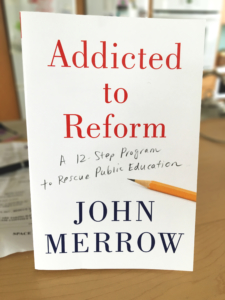 Is America addicted to education reform? My guest today, John Merrow, says it’s time for America to enter a 12-step program to fix its K-12 public education system.
John argues that the countless reforms he’s reported on for over four-decades have addressed the symptoms of the problems facing American education and not the root causes.
John Merrow began his career in 1974 on National Public Radio before becoming an Education Correspondent for PBS NewsHour and the founding President of Learning Matters, Inc. Now retired, John is an active writer on TheMerrowReport.com.
His new book is entitled Addicted to Reform: A 12-Step Program to Rescue Public Education, which will be published by The New Press on August 15. Be sure to check out the e-book which features videos from John’s illustrious career.
Citation: Merrow, John, interview with Will Brehm, FreshEd, 85, podcast audio, August 7, 2017. https://www.freshedpodcast.com/johnmerrow/
Transcript, Translation, and Resources:
Today we look at entrepreneurship education in Tanzania. You might be asking yourself, “Hey, didn’t FreshEd recently discuss entrepreneurship education in Rwanda?” You’re right. We did.
Obviously, the idea of entrepreneurship education is a global phenomenon, found in many different countries. As such, we need to understand what it is in each local context, who is promoting, how it is spreading, and what it means for education and society.
My guest today is Joan DeJaeghere. She has a new book out called Educating Entrepreneurial Citizens: Neoliberalism and youth livelihoods in Tanzania. For Joan, entrepreneurship education cannot be separated from neoliberalism, the contemporary form of capitalism that emerged in the 1970s.
Her book explores the multiple and contradictory purposes and effects of entrepreneurship education aimed at addressing youth unemployment and alleviating poverty in Tanzania.
Joan DeJaeghere is a Professor of Comparative and International Development Education in the Department of Organizational Leadership, Policy, and Development at the University of Minnesota.
Citation: DeJaeghere, Joan, interview with Will Brehm, FreshEd, 84, podcast audio, July 31, 2017. https://www.freshedpodcast.com/joandejaeghere/
Transcript, Translation, Resources:
Today we talk about intercultural competencies. These are the attitudes, skills, and knowledge that enable people to see from different perspectives, helping us get along together as humans. These competencies seem particularly relevant in our current political climate.
My guest is Darla Deardorff. She has spent the past decade thinking about intercultural competencies. What are? Can scholars agree on a common framework? And is it possible to measure them?
For Darla, intercultural competencies are as vital as math and science for education.
Darla Deardorff is the Executive Director of the Association of International Education Administrators at Duke University.
Her latest co-edited book, Intercultural Competence in Higher Education: International Approaches, assessment, application, was published by Routledge in June.
Citation: Deardorff, Darla, interview with Will Brehm, FreshEd, 80, podcast audio, July 3, 2017. https://freshedpodcast.com/deardorff/
Will Brehm 1:54
Darla Deardorff, welcome to FreshEd.
Darla Deardorff 1:57
Thank you so much. It’s a pleasure to be here.
Will Brehm 1:59
So, you’ve done quite a lot of work on intercultural competencies. What are intercultural competencies?
Darla Deardorff 2:07
Well, that can have a very long answer, but I will provide you with the short one for now. And basically, intercultural competence is about interacting successfully with those from different backgrounds, whether that’s ethnic, religious, socioeconomic, and so on.
Will Brehm 2:26
And so, what would that actually entail? What sort of competencies are we talking about?
Darla Deardorff 2:31
I’ve actually spent about a decade doing research on intercultural competence and trying to understand basically what’s necessary for us to get along together as humans. So, for me, that’s really the big question and the driving question behind this research. The work that I’ve done so far has resulted in one of first research-based definitions and frameworks of intercultural competence. There’s been actually over 60 years’ worth of scholarly work done on this concept. But very little of that has been research-based. So basically, I was interested in seeing whether scholars could come to some consensus as to exactly what is intercultural competence. And so, the results came about then in the framework from the research I’ve done. In terms of what’s necessary for us get along together, we can look at it in terms of which attitudes, which skills, which knowledge areas are really essential to intercultural competence. And so, I’m happy to go into more detail around each of those areas if you’d like me to, but it really comes down to knowledge, skills, and attitudes that are absolutely essential for intercultural competence. And then that results in some, what I’ve termed “internal” and “external” outcomes. In the end, what we’re looking for – what we’re hoping for – is behavior and communication that is both effective and appropriate. And both of those words are really important because often, we might think about folks who’ve been really effective in what they do but quite inappropriate in how they go about doing it. And for intercultural competence, we need communication and behavior that’s both effective and appropriate to the individuals that we’re interacting with.
Will Brehm 4:33
So, could we go into some more of these specifics on the attitude and the skills and the knowledge just to get a better understanding of these competencies?
Darla Deardorff 4:44
In recent research I’ve done, there were three key attitudes that emerged as being absolutely essential to intercultural competence development. And those have to do with curiosity of really wanting to learn more about the other person; openness, open-mindedness, and respect – of truly valuing the other as a fellow human, especially when we don’t agree. And so those three attitudes are considered to be absolutely essential to intercultural competence. In terms of the knowledge areas, quite a bit focused around cultural self-awareness – being able to understand from others’ perspectives. And then, in terms of the skills, it has to do with listening, observing, relating, evaluating, knowing what to do with the information that we receive. And then together, those knowledge, skills, and attitudes brings us to this point of what happens inside an individual. This is termed the “internal outcomes” that will ideally help us become more flexible and more adaptable in how we relate to others. That in the end, we will have developed some empathy. And really being able to begin to see the world from others’ perspectives, even though that’s really actually quite tough to do. And then with the internal outcome comes the external, which I’ve already described in terms of the behavior and communication that’s both effective and appropriate in intercultural situations and situations when we’re interacting across difference. And that occurs every day because none of us are identical to each other. And so, we are interacting across difference every day. And so really thinking about what that means, what that looks like, and what’s necessary for us to be successful in those interactions.
Will Brehm 6:39
So, is there, in a sense, a universal definition of intercultural competencies that crosses cultures around the world?
Darla Deardorff 6:48
That’s a really good question, and that was actually one of the questions I had coming into some of the research I’ve done. The short answer is “no,” but the research I have done, like I said, is the first consensus-based definition and framework around intercultural competence, and that framework has certainly found resonance in quite a few different cultural contexts. For example, that framework is being used in in places like China and Mexico and Brazil, and in lots of different places around the world. But that being said, certainly, the elements I described can be contextualized for specific situations and interactions. But interestingly enough, there was only one element within intercultural competence that I described that all the experts agreed on 100% as being absolutely essential to intercultural competence. And that was being able to see from others’ perspectives. And so that has led me to my own burning question over the last several years in terms of, “What are other perspectives on intercultural competence?”, and that has led me to do research in China, in South Africa, in Japan, and other places to try to really understand, “What does this look like in other areas around the world?” Because so much of the literature around intercultural competence has really come out of the global North, predominantly from the United States and from Europe. And so, trying to understand what are other perspectives, and not surprisingly, those can be quite different.
Will Brehm 8:34
How so?
Darla Deardorff 8:37
Well, for example, in the global North, the focus is predominantly on the individual. And as I was describing this initially, I talked about the knowledge, skills, and attitudes of an individual. And when we start to look at other perspectives and definitions of intercultural competence, there’s a shift in some cases, even with how one views the individual. So, for example, in South Africa, the concept of “Ubuntu” comes into the conversation. And for those who may not be familiar with Ubuntu, it talks about how “I am because we are. We are because I am.” That it’s impossible to separate the individual from the group because what I do impacts others and vice versa. So even the individual identity can shift, depending on the context. In other cultures and other regions around the world, there’s much more of a focus on relationship and the relational aspects of intercultural competence. So, the focus again is not so much driven on a single individual and the knowledge, skills, and attitudes of that individual. Interestingly enough, UNESCO of the United Nations tried to do a project looking at regional perspectives on intercultural competence. They weren’t trying to necessarily come up with a universal definition, but a few years ago, I was involved with this project, trying to look at what are various regional perspectives around the world. And it resulted in a publication that actually can be downloaded from UNESCO, simply copying their cultural competencies. But nonetheless, there wasn’t a universal definition even then that that was developed. Again, because of these different variances when we really start to delve into the different perspectives around this construct.
Will Brehm 10:29
It would seem to me that language would play a very large role in being able to understand “the other,” to be respectful, and see from other perspectives. So, what is the role of language and foreign-language in intercultural competence?
Darla Deardorff 10:46
Another excellent question, and one that I also had, particularly because I was coming from this more from a language teaching perspective. I have a background in teaching English as a second language, so I personally feel that language is quite important. Interestingly enough, in the research I did, the experts involved in my study could not reach consensus on the role of language in intercultural competence. Which really surprised me. And I had a colleague who did a similar study with a different group of experts, and he had the same finding: They could not reach consensus on the role of language.
Will Brehm 11:24
Why?
Darla Deardorff 11:25
So, when I went to try to follow up on this to say, “Why?”, it just seemed like that would be a really important role. The experts I worked with most often cited the case of knowing “fluent fools,” of those who might know the grammar and vocabulary of a language but be interculturally incompetent in navigating the cultural parameters. And so, they were saying it was insufficient in terms of achieving intercultural competence. And so, therefore, they could not necessarily reach consensus on the role of language.
Will Brehm 12:10
And what about the other side? What were the people that disagreed with these experts who were saying that they were fluent fools? What about the other side?
Darla Deardorff 12:21
That seemed to be what really came up the most: that it was necessary, but not sufficient, for intercultural competence. That in the end, it was much more about the attitudes, about how one approaches others initially, out of respect and openness and really wanting to learn about the other. That’s what really mattered more.
Will Brehm 12:47
It’s strange because to really understand someone else, it seems like you would have to be able to actually communicate.
Darla Deardorff 12:53
It does seem like it, and that was certainly part of that external outcome finding in my own research. But interestingly enough, of course, communication involves more than words. Words are just a small part of all of how we communicate.
Will Brehm 13:11
So, let’s shift gears now to look at the role of education systems. So, now that we have an understanding of intercultural competencies and general understanding, what is the role of schools and education in the process of cultivating these intercultural competencies?
Darla Deardorff 13:28
Well, one important finding from my research is that intercultural competence development is a lifelong process for teachers and for students. And so, there’s no one point at which any of us becoming interculturally competent. And that has real implications then for schooling and for education to understand that students as well as teachers are in different places in the developmental process of intercultural competence. That a “one size fits all” doesn’t necessarily work for all students. That the preparation and training of teachers around intercultural competence is absolutely critical. And so, it’s important to recognize all those different pieces when we are talking about education systems implementing intercultural competence development. And so, as we look at what’s really important, first it starts with the curriculum. And not just the content, the knowledge that is taught, but actually also the delivery and the teaching methodologies. And I think, to what extent does the curriculum reflect different perspectives that is such a key piece of intercultural competence of being able to see the world and issues and so on from different perspectives? So, to what extent are those represented in the curriculum? And within the curriculum, it’s important to also ask, “Whose knowledge is being privileged, and whose voices are missing?” And so, these are some examples of key questions that really need to be explored further in terms of the curriculum itself and how it’s delivered. In terms of how to develop intercultural competence, research is showing the importance of experiential learning and of really, even moving beyond the classroom. Or if in the classroom, it’s looking at the teamwork that might take place, the actual interactions. At the undergraduate level of post-secondary education, there have been some studies that show the value of “service learning,” meaning getting the students into the local communities, having them interact with those who live there, and learning from each other mutually. And of course, study abroad has traditionally been a go-to way of developing intercultural competence, particularly at the undergraduate level. But just to add in a point here that just sending students abroad does not result in making them interculturally competent. That is a myth that we really need to address. There’s so much that goes into a quality experience, whether that’s a cross-border experience or even within our own local communities, in terms of how we are able to connect with others, and as to whether that actually results in enhancing intercultural competence development or not.
Will Brehm 16:34
And what about some of the politics here? I mean, it seems like talking about, “Does national curriculum reflect the voices of the different ethnicities or cultures inside of a nation-state?” That would seem to be not necessarily what the ruling powers-to-be would necessarily want, particularly in some conflict areas or places that have many ethnicities and cultures. How do politics figure into this notion of intercultural competencies?
Darla Deardorff 17:10
Well, quite a bit, particularly in regions of the world where there is a national curriculum. Of course, I’m based in United States, and there’s not necessarily a “national curriculum” here, per se. But certainly, in places where there is, that definitely enters into it. Quite heavily, actually. And so, it’s important to really consider the context, including the political, social, historical, economic, etc., that goes into really the whole contextual piece and understanding the best ways to try to address intercultural competence.
Will Brehm 17:49
And continuing on about the role of education in schools and teaching intercultural competencies, are these competencies being assessed anywhere?
Darla Deardorff 18:00
Yes, they actually are. I would say, particularly at the post-secondary level, there’s been a huge emphasis in recent years in how we assess intercultural competence. And this has been another area of my own research and work. In fact, I had a book come out two years ago on demystifying outcomes assessment for international educators, where we really delved into the logistics of what that looks like and trying to make it very manageable in assessing intercultural learning. But then it’s also taking place within the primary, secondary school as well. And in fact, next year, in 2018, the PISA program in the National Student Assessment will include global competence as part of that assessment, and I’ve been involved on the expert team in working on developing that.
Will Brehm 18:52
So, I mean, this brings up an interesting question. So, PISA, the Program for International Student Assessment, is given in many countries all around the world, and it’s supposed to be some sort of a standardized test in math and science, but now perhaps intercultural competencies. But earlier, you said that one size doesn’t fit all or doesn’t work for all when it comes to teaching intercultural competencies. So how would a standard test actually work?
Darla Deardorff 19:21
Yeah, that’s a really good question. And that’s something we’ve really been struggling with as we’ve been looking at this for PISA and for global competence because that is a standardized test. And based on the research and work I’ve done, if we’re really serious about assessing intercultural competence of global competence, in the end, it’s really important to use a multi-measure, multi-perspective approach to assessing this that generally, even though there are over 140-some different instruments existing that measure some elements of intercultural competence of this construct, that there’s no one best tool. There’s no one tool that can really assess and measure the complexities of this. And so, given this and all the work that’s been done around assessment, as we approach the PISA standardized test, we decided that there’s no way that that PISA can assess the whole of, and the complexity of, global competence. And so, we decided to prioritize and hone in on a few key areas that a test could perhaps measure within the parameters of PISA. And so, there will be a lot of caveats around the reporting of this. And really focusing much more on the cognitive levels associated with global competence because that’s a bit easier to assess through the PISA parameters.
Will Brehm 20:49
Is there anything that worries you about including intercultural competencies on PISA?
Darla Deardorff 20:56
Not necessarily worries me. I would say, in general, as we discussed and talked about this, it’s really positive that the OECD and the countries that are involved in this want to include this as part of the PISA assessment because it really helps to raise awareness of the absolute importance of global competence, particularly now more than ever given the political climate realities around the world. And that it allows for opportunities for discussion at the ministerial levels on down to the school level. And so, in general, we see this is a very positive development. We understand there’s not going to be any perfect test or measure of global competence, but it really is very good in terms of generating awareness and discussion, and hopefully, in the end, perhaps integrating it more into the various educational systems around the world. Because in many ways, there’s nothing more important to address through education and in society than global competence.
Will Brehm 22:02
So, I just recently read a UN report that said that in 2016, there are 65 million displaced people in the world. They say that’s a record since recording the data has begun. So, does that put new urgency on the need for intercultural competencies inside education?
Darla Deardorff 22:24
I would say that it does, and not just this huge number of displaced people, but also the backlash we’re currently seeing to globalization. The increase in hate incidents around the world. There’s just such a need for educational systems to address intercultural competence, both within the schools at the student level, but then also it comes back to teacher preparation, teacher education programs, and how universities are preparing and educating the teachers to help guide the students in their own global competence, intercultural competence development. This is just absolutely crucial. And in fact, I’m reminded of a quote from Martin Luther King Jr., which I find incredibly relevant today than ever before. When he said, “We must learn to live together as brothers and family or perish together as fools.” This is not something that comes easily. We have to learn how to live together in order to survive as a human family sharing this planet. And so, I see that the educational systems around the world can play a really key role in this endeavor.
Will Brehm 23:51
And what would be some of the major in the sense roadblocks to achieving education systems, teaching intercultural competencies? Are there actually opponents to intercultural competency?
Darla Deardorff 24:06
I think there are, and particularly the roadblocks – you’ve already kind of alluded to this earlier – in terms of the various policies or structures that may be in place that would already prescribe a certain curriculum and certain ways of teaching and so on. So, I think, depending on the contexts of the educational systems around the world, some might prove more limiting than others in terms of what would be possible. And certainly, this can be seen as a threat in terms of opening it up to various perspectives, including indigenous perspectives or other perspectives of minority groups that might normally not be heard or represented in the curriculum or in the schooling. So, I know there are those who might be concerned about this. But in the end, it really is in the best interest of humans to understand what is necessary for us to learn to live together.
Will Brehm 25:12
And so, are you hopeful that humans will be able to actually embrace these ideas and introduce them into national education systems?
Darla Deardorff 25:22
I am hopeful. We’re encouraged by, for example, the developments of PISA and looking forward to what might result from the 2018 PISA test around global competence and seeing the ramifications of what that might have in terms of educational systems. And the continued conversations. I know at the post-secondary level, there’s been a huge increase in terms of the conversations around intercultural competence within undergraduate education in numerous countries around the world. There’s an increased interest in this and in terms of how do we best prepare our students to live in such diverse societies around the world, because regardless of where they live, there’s a good chance they’ll be working with people who are different from them. And so, it really is in the best interest to understand, “What are the best ways to prepare students to really function and navigate within the diversity that we find in today’s society?”
Will Brehm 26:33
Well, Darla Deardoff, thank you so much for joining FreshEd. It really was a pleasure to talk today.
Darla Deardorff 26:38
Thank you again so much, and I encourage all your listeners to continue working, as we all continue to work, toward making this world a better place. Thank you so much.

This will close in 10 seconds