Why did Sweden cancel its agreement with Elsevier?
OverviewTranscriptTranslationResources
Today we continue our exploration of the Fourth Industrial Revolution and what it means for education. Last week, we looked at comparative education as a field. Today we look at teachers. What are the prospects and perils of the fourth industrial revolution for teachers?
My guest today is Jelmer Evers. Jelmer is a teacher, blogger, writer, and innovator. He teaches history at UniC in the Netherlands and works with Education International, the global federation of teacher unions. He was nominated for the global teacher prize in 2012 and is known for his book called Flip the System.
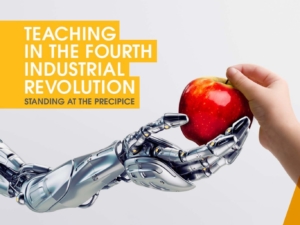
Today Jelmer and I discuss his new co-edited volume Teaching in the Fourth Industrial Revolution: Standing at the Precipice, which was published by Routledge earlier this year.
Citation: Evers, Jelmer, interview with Will Brehm, FreshEd, 117, podcast audio, January 4, 2018. www.freshedpodcast.com/jelmerevers
Will Brehm: 1:49
Today, Jelmer and I discussed his new co-edited volume “Teaching in the Fourth Industrial Revolution: Standing at the Precipice” which was published by Routledge earlier this year. Jelmer Evers, welcome to FreshEd.
Jelmer Evers: 2:04
Thank you. Glad to be here.
Will Brehm: 2:06
Why does it seem like every other news article that I read lately mentions something about the fourth industrial revolution?
Jelmer Evers: 2:15
Yeah, I think you are right. That is also I wrote the book. I think there are several reasons for that. I think there is a general fear of disruption, I think people can see that technology is having a major influence on how we live and work and also in education.
But I don’t think that is just it, not just a fear, which is can be right. I think it’s also to do with sort of, the techno-optimism that is sort of like pervasive in the last 10, 15 years are like a dominance of Silicon Valley entrepreneurship start-up culture.
So technology is cool and happening. If you compare to education, education is sort of still an old school. Sort of this is techno utopianism to it.
I also think, at least from an educational point of view, the idea that technology will make these old progressive dream come true, personalize education, I mean, we have we ever been having these discourses for at least 200 years. If you look back at all these, like, older thinking, and books and articles on education, you can still see the similar languages pop up, and now it has the name Fourth Industrial Revolution, or personalized education to it. I think the idea is and there’s grain of truth in it, that it makes it more easier to allow this to happen, although, with lots of caveats.
Fourthly, and that’s something I only learned, like learn later on at least in my teaching career when you start look outside of the classroom, and schools and system etc. has all these policy networks that are out there that have been out there for a long time, and also have been latching on to sort of like this, this whole techno utopist (view) vision of society and also in education.
So this whole 21st Century Skills debate is predating the idea of the fourth industrial revolution. And that’s already been out there for quite some time, at least in the Netherlands, like early 2000s, we’ve been talking about this, and as a means also for politicians, but also for teachers to push for innovation in education. And now we have this sort of like more profound technological change, which I do think is there embedded into it. So that’s why I think it has become stronger, there’s the sense instead of that there is something going on, and it makes it more easy for these narratives to, from whatever viewpoint to take a look at education in that way. But for me, as well, it’s also part of these bigger, bigger, longer neoliberal discourse that has been going on as well and people have been latching on to it, like I would almost feels like GERM 2.0. like the Global Education Reform Movement, as Pasi Sahlberg points out, and now we’re having sort of like these big tech companies pushing into that space as well. And with this teacher ambassadors, and the Google ambassadors and the Apple ambassadors, and it’s a really powerful narratives are both from an optimistic point of view, but also from a fear point of view. So that’s it. That’s what I think, where I think that’s why it’s there.
Will Brehm: 6:03
So the fourth industrial revolution is about what? What is the revolution?
Jelmer Evers: 6:11
Well, I think you have to also look at who coined the term Klaus Schwab from the World Economic Forum in a yearly gathering in Davos, mostly by CEOs, and sort of like academics who buy into that stuff.
And his book has been quite influential. So he coined this term, what’s going on, and it’s his idea is that there was the first Industrial Revolution, of course, steam engine and the second one, early 20 century, late 19th century, with electricity, oil, like mass production, the whole birth of the Ford era and Taylorism, but in the 60s with these reflect the birth of the digital age that the more simple digital revolution, which of course, is a major impact on communications are productivity. And now he’s saying there’s a fourth industrial revolution. And it’s sort of like an exponential technology, where different kinds of strands of technological innovations are now being combined, and accelerated. And you have to think about like AI and robotics, nanotechnology, biotechnology, and like quantum computing, those kind of things. And they’re all like interacting with one another. And there are new industrial sectors, like data scientists, those kind of things to do that, it’s ubiquitous all over the place because everybody needs to be a data scientists nowadays.
So and like gene therapy and DNA. And I mean if you look at it for the whole list that he goes through, it is quite remarkable, I think, what is going on. So you definitely cannot discount the technological change that is going on, I can, I think we can see that all around this. But I think he coins towards that there’s this whole political economy sphere and context to it, but he stays within a certain frame. And I think that’s sort of like the biggest issue that we it’s not a technology that we need to tackle per say, it’s more like, who profits from it? Who owns the technology? Who owns the data? That kind of stuff.
Will Brehm: 8:29
And how are people talking about the ways in which the fourth industrial revolution will impact education?
Jelmer Evers: 8:40
That’s a very interesting question. And that brings me back I think, to the progressive strands and philosophy that we have in education. So for example, if you’re looking for, from a really practical point of view, people are really pushing sort of actors, adaptive platforms, these tutoring platforms that can help students learn at their own pace, maybe you don’t need a teacher anymore, maybe the platform is good enough with all the learning materials, the videos, and the readings, the interactivity, that’s more easy to produce. So there’s already been there. But now sort of like with these algorithms and a promise of activity, I think that’s the main focus right now.
And also that’s where it has the biggest impact. And I think there are some, like, for example if you look at like math skills, basic math skills, I see with my own children, so they’re practicing on the internet for the whole, like drill part of education and teaching, it actually helps. It can ease the formative feedback cycle, that’s great with children work with them on that. So you can outsource a little bit of sort of formative aspect. I think that’s actually a good thing.
But if you look at what kind of articles are you reading, and if teachers will, we will be replaced with AI, and, you know, that kind of stuff. And that’s quite worrying. And it’s completely besides the truth and reality, I think, there are different things going on. But it’s sort of like the basic things. And if you look at the impact of technology in another level, which I think is more progressive is sort of maker education. And so all those technology associated with that as a service with 3D printing, but also like, it’s easy to program, little little computers, etc, those kind of things are having a major impact. And students can be producers, and they can interact with students all over the world, etc. So, I think there is the problem is, there’s this true promise of progressive education, but it’s also sort of like hijacked by more behind the scene by a more standardized form of education. Because if you look at sort of the oldest platforms, they’re trying to sort make these little data points everywhere like the learning goals and then you are run through this maze as a student without the help of any teacher and that sort of like the old standardized dream. So it has this two-face thing to it.
Will Brehm: 11:25
Have you experienced any of these two different faces of the Industrial Revolution 4.0 or whatever it’s called the fourth industrial revolution inside your own classroom?
Jelmer Evers: 11:38
Well, you know, for example, the whole networking, it connects with people all over the world, I can connect with class, with people and other students from all over the world, they are connecting themselves, I mean, I get it, they’re doing it anyway, and I get them anyway.
So that aspect is there, it makes it more easy for me, for example, to create a learning environment where they do have lots of choice, I’m not just fixed to a textbook, for example, while I do also use textbooks, because the students enjoy them, I think working from papers way more efficient than then digital technology that is good or not all these studies that have come out lately that have warned us about sort of like not to go too deep into the digital world, from a learning aspect, but also from an addictive aspect.
So it’s there. And what we’ve also seen is that these types of technologies are being pushed. So we have a major change, we’ve just changed Microsoft, for example, the Microsoft environments, and I don’t think our school which is quite autonomous, and we, as teachers were on board with that you get bombarded with all these actors, policy actors, networks, research people try to sell you stuff. It’s a huge market, also in the Netherlands and more worryingly, I think what we’ve seen, and it was even, I think people from my own school boards were like, part of this, they’re looking into sort of, like, we have a teacher shortage so we can’t pay for it. So we’re going to look at other scenarios. And that means sort of like, and then we’re actually talking about using AI and all these platforms to invest more in that. It will be more cheaper in the long run. So it is definitely affecting us and me still on the ground and lots of different ways, I think.
Will Brehm: 13:44
Do you literally have people coming into your classroom or your school trying to sell you the latest education technology?
Jelmer Evers: 13:52
Well, they’re trying to and trying to approach you, of course, and through different ways, it’s through school leadership, or the board, etc.
I’m usually approached quite often because I write these books and quite well known in the Netherlands, so that sort of like, also, they want to work with us, and we’ve got this product, etc. So that’s definitely a thing.
Will Brehm: 14:14
How does that work? Like, what’s the economy there? Do they want to give you some sort of monetary kickback? Or, like, how does it work?
Jelmer Evers: 14:23
No, no, that’s never the case. That’s the interesting part. And that’s why I always say, No, I said, I mean, I’m happy to consult in any way, as long as you pay me for it. And then usually the conversation stops.
So it’s also a very interesting now it’s just, we give you your, you can try our product for free, and then with your writing little piece on it, or we want to try it out and give us some feedback. So I sort of like free labor kind of thing. So I would say no to that, whilst I do think there are interesting things out there, that definitely help me in my teaching, but it’s definitely a big thing, you can see the major publishers moving from textbooks towards they’re all trying to create this platform, and sort of like trying to create a monopoly and like the major book distributor. And you can see that there are really changing their course, into a sort of, like, a platform kind of way. And they’re actually so big, that they might have a chance for that in the Netherlands.
Will Brehm: 15:26
What is the platform by the way?
Jelmer Evers: 15:28
It’s sort of like, where content’s almost free, but where you want to be where the interaction is ready, where you can gather data, and sort that data and so that’s, you know, that’s sort of, like, if you look at Uber and Airbnb, etc, so they don’t own anything anymore. They don’t own the books anymore. But he might not even own a company anymore. As long as you have enough people on a platform, and it gathers data so that’s a revenue stream, and huge revenue streams for Facebook and Twitter, etc. So, or also doing. And if you have all these learning interactions, then you’ve got all these data points, you can fill this correlations and then you can sell this as look, we know that this works, they don’t really know what works because just the correlation but that’s the days they’re sending a sort of like this model of learning also still don’t know a lot about learning. So that’s sort of like if you can occupy that space. And a lot of people are trying to do that.
Will Brehm: 16:28
So let me just try and get my head wrapped around this. The idea here is that there are these companies, these education businesses that are creating online platforms that they are trying to get students to use and teachers to use. And then while they’re using these platforms that offer all sorts of content, like you said, maybe that has been developed for free externally, they then are collecting data points on how the students interact, and use that material, and then somehow analyze it, and then sell the analysis back to the school. That is the revenue?
Jelmer Evers: 16:39
Yeah, so those kind of things, and also for other products. So you can build off products on that platform as well. And what I’ve been looking for, for example, so I’ve been using all these different kinds of tools, extra credit, and we’ve got a virtual learning environment and all these other things, but they’re not talking to one another. So for me, it would be really useful to have a single point of view that like people are talking about dashboards, for example, learning dashboards. If you can organize that, and then you become sort of like the Spotify of education because you’re already entry point to everything. So you can ask revenue from the people that are providing apps. So you can you can ask for like, small fee from the schools and the students, you can sell your data to other companies again, so this is sort of like how people learn. So that’s sort of like the whole that’s what a lot of companies are trying to do around the world at the moment even in the developing world.
Will Brehm: 17:01
And these sort of companies are I mean, they’re obviously working inside public schools as well. Is that correct?
Jelmer Evers: 18:08
Yeah. So (we have we haven’t) we have a little bit more of a different system in the Netherlands it’s completely privatized nonprofit but that’s more from a historical point of view so it was that religious education was funded just like public education and you know the whole Neoliberal reforms in the end of the 90s early 2000s every school was privatized but with a really strong accountability system Inspectorate etc. Profit is like a big no go, although we have a lot of scandals here in the Netherlands, increasingly, so.
So it is we still consider it public, but a lot of people don’t know how privatized it actually is. And it also makes it more easy to sell this kind of stuff. So if you look at how the government operates, when they’re talking about ICT and ethic and they’re creating these policies, the only people they’re talking to, are actually like the representatives on our boards, like way high up, and the publishers and the ethic people and technology people. So teachers don’t have any say, or schools themselves don’t have any say in those policy networks. They are huge, are well funded. And they know how to approach the ministry, etc. And so it’s been quite worrying. And I’ve been, as a teacher be quite disgusted by the whole direction that has taken the last like eight years or so.
Will Brehm: 19:24
And what direction has that taken in the last eight years?
Jelmer Evers: 19:28
I think we’ve managed to stop a lot of neoliberal discourse, like the standardized testing and the top down managerial sort of like culture that is sort of completely embedded in our schools. I think we’ve managed to stop that. But the whole privatization aspect of it and the whole more it’s more easy to start schools and then people want to do away with the central exams, it becomes more easy to penetrate sort of like our school system through these networks, where our teachers don’t have any say. So I took the whole public aspect of our system is broken without it being really clear to people. So for me, that’s sort of an example of what you see around going on around the world, not just in the Netherlands, it’s happening in a strong system like the Netherlands where you can imagine and you know what’s going on in the United States, but also in the developing world and in African countries, but also Asian countries. I mean, it’s huge and well organized like I see here in the Netherlands as well. So let’s that’s going against I think, I think we’ve another one a lot of sort of, like discourse battles against sort of like that’s how standardized narrative and now we’re up against a new sort of like narrative. And it’s not on a lot of people’s radars. It’s progressive side to it. And that makes it more difficult to counter I think and even be aware of it.
Will Brehm: 20:58
How would you define that progressive side?
Jelmer Evers: 21:01
What do you mean like?
Will Brehm: 21:04
Well, you were saying that education technology sort of furthers the privatization efforts inside schools, not only in the Netherlands, but around the world, and you’re trying to in a sense mobilize against that movement. But because perhaps education technology has this progressive side to it and makes it a little more difficult to mobilize that resistance, can you talk a little bit about that progressive side?
Jelmer Evers: 21:35
Everybody wants to personalize as you want to bring out the talent of the individual student, that’s a given. That’s sort of like one of the major goals, that’s what we do as teachers. If you want to try to build a good relationship, you want to see what’s in there, what comes out of it and improve on that you want to give him every attention or her every attention that he can. So if somebody says, well, here’s the solution that we can give you a real personalized education. Well, before it was just a standard industrial, Prussian solution which is complete nonsense, of course model well it’s based on a faulty premise, that it’s just sort of like jumping through hoops and running through a small like, standardized maze, that it’s sort of like standardized education in disguise, and in another ways. And it’s also like, at least in the Netherlands, and I think definitely in the West, a formative assessment has really taken off in classrooms, and teachers are really aware of it. And I think more research informed on these kinds of developments. And it also buys into that kind of narrative. And it actually helps I’m not against that, per se. But if people then take it to the next level, and start replacing, and like a narrative replacing teachers, and we don’t need teachers anymore, or they’re even better than teachers then it becomes really, really problematic, because those technologies can do that whatsoever at all. If you look at sort of, like what AI experts are saying, it can do and really specific thing really, really well.
But a job and especially in education is so much more than that. And it also has to do with empathy and ethics and morals and bringing up the child as a society, and I sort of like as a and the school is also a small community where it creates sort of like new communities and prepares him for a wider world, which isn’t just about economics and jobs.
So if you, I mean, artificial intelligence can never do that. At least definitely not for the coming 50 years. If you look at all these what AI experts are saying. But at the same time, if you don’t open up, like the times education supplement, for example, it says, well, we need to be really afraid of AI, because they’re going to replace us in that’s just not true. So where’s this narrative just coming from, and then it becomes more easy to sell this kind of things well. But we’re personalized, and how can you be against personalizing education.
So that’s sort of like the real difficult thing I think people are grappling with. And if you’re also then offered incentives to be part of a global network that you can visit conferences, and it’s being paid for, etc. So like, our teachers are now also sort of like in these corporate networks and big tech networks, and that those are the best-funded teacher networks around the world. And they’re having this corporate there, they’re now having a corporate identity instead of a professional identity. So that’s, you know, those are the dynamics that are going on under the heading of personalized education.
Will Brehm: 24:50
It seems slightly analogous to the way in which medical or pharmaceutical companies sort of engage with the medical profession.
Jelmer Evers: 25:01
Yeah, I think there’s definitely and I hadn’t really thought about that way yet. I will have to pursue that as well, I definitely think that’s, that’s the case, and I’ve got a few of my friends are general practitioners, and they definitely have an issue with it. And I know there’s a whole internal debate, like from a professional point of view, but there are lots of people who are buying into the system that goes, you know, it gives them opportunities, it gives them a platform, and it’s the same kind of dynamics. And the problem is, like, the people who are fighting for public education are always underfunded, less network, we’re not at the vows, so to speak. So yet, so that’s you know, and you want to get your voice out. And actually, a lot of people are doing good work. And some of you know, some of the lesson plans that are that they’re talking about, and, and pushing out and really valuable. But if they’re part of this bigger discourse, and I read a, there was a series of the New York Times about these networks, but this kind of networks how Google and Microsoft and Apple are opening up their schools to sell their products.
I don’t think we, as a profession, we have had a real genuine discussion about this. And it also becomes that we’re because we were quite a weak profession, I think, in another sense that we don’t have standard lots of standards, professional bodies, unions have been focusing on bread and butter issues, and it should be way, way wider than they do now. So there’s so many things that we still need to organize around and do and we need to do it globally, I think. It is a global discussion, because these operators, they all operate on a global level. So you can never do it in on a national level, or just on a national level.
So yeah, that’s sort of like the, there are so many things that you need to be involved in. And if you’re, then as a teacher, for example being educated as just focusing on pedagogy and just focusing on the classroom, and you’re not sort of like, brought into this wider discussion, it makes it really hard for people to resist. And that’s also what happened, I think, in the 90s and the 2000s people were, teachers were really being pushed back into the classroom and just sort of like it, then you’ll be, you have to do it you’re told, so this whole history that we’ve had, at least in the 80s and 70s and 60s and more critical pedagogy, but also, like, a really strong profession that’s also being has been undermined. So it sort of makes it really hard to fight back, I think, on these issues.
Will Brehm: 27:41
And so what can teachers do? I mean, if they had, say, a stronger profession, or more professionalized like you were saying, and these global networks, teachers still need to be very literate in all of this new technology, and have a voice at the table, in a sense on how it can be incorporated. So in a sense, how do teachers in your perspective, sort of resist or engage with this large network of education businesses that are in a sense spearheading this fourth industrial revolution?
Jelmer Evers: 28:22
Well, first thing is, I think there’s the idea of a network teacher is really powerful. So they’re actually tapping into something that is really worthwhile. I think, also, if you look at professional development, and why teachers stay in the classroom, that is networking aspect, and collaborative learning is extremely powerful. It’s probably one of the best ways to retain teachers as well, but also for us to become better as a profession. So I think what we need to do is sort of like, try to find ways to support those networks. But then also when we start talking about pedagogy, and good and what is good pedagogy, educational technology, formative assessment, we also start to sort of like pushing these narratives, what education is for, what are all the actors involved in education, what kind of role are you taking, so the networks are always there. And there’s this really powerful network here in the Netherlands, but globally, and I’m talking to teachers from United States, Australia, Africa, African countries, like Uganda, South Africa. So I mean, we’re already connected. It’s just that it doesn’t have a real organizing bit to it. And that’s what I think we’re old fashioned unions that unionism comes in. And I think they need to take a wider approach from just focusing on salaries, for example, or workloads, it’s about being a profession. And I think a lot of unions have already had that, but they also sort of like, let themselves be pushed into this, no more narrow narrative. But just focusing on grassroots networks is not good enough. If you look at sort of, like the field revolutions in the Middle East, the occupy movement, etc.
So if there’s no powerful, political, organized, well-funded movements, combined with this, sort of, like more grassroots network, social media kind of activism. If you can combine those things, I think you have a really, really good chance of sort of, like changing the narrative and our own sort of like what we’ve learned here, at least in the Netherlands, if you if you have a powerful narrative, and if you’re going to influence the general public, you can turn those things around. So we moved away from standardized testing. And I think there’s, there’s a distant, a new sort of, like, powerful grassroots movement and Facebook group that popped up, and they were sort of like a catalyst for a national strike. And you’ve seen those things pop up in the United States as well. So if they’re even comes from like, the, the core of the resistance, like in the, in the red states, Red for Ed. So I think everything is there already, I think, but we need to be more conscious of this. And I think it also starts with being in teacher education.
I don’t think I was sort of educated enough of being (in English or not being) that I was part of a profession and being proud of being part of the profession, what does it mean to go beyond your classroom, and that’s something that we need to take up as well, start with, you know, the people entering into our profession and taking this more holistic approach. And I think everything so I’m quite optimistic actually, that we can achieve change, like flipping the system, that’s what we call it and putting the teachers at this center of it. And because I’ve already seen so many positive changes within schools themselves in school district, but also even on a national level, like New Zealand started turning back on lots of like, toxic neoliberal reforms just recently, so that’s sort of like gives me a lot of optimism that we can turn this around, but it does need to be a conscious effort. And, and that’s we’re still not at that stage. And that’s what we need to push for.
Will Brehm: 32:21
It seems like you’re also advocating for flipping the narrative of the fourth industrial revolution from either techno pessimism or seeing technology as some utopia to actually saying, Wait a second, humans use technology, and it has to, therefore be a political process as to how we use it to sort of flip the narrative completely.
Jelmer Evers: 32:47
Yeah, exactly. And it’s, you know, I’m not a Luddite. I love work, I actually came into, like, education, innovation. I think, like most teachers, through educational technology, that’s a starting point for new apps and new things that you want to try out and actually see, that’s working. And so their technology in itself is not bad. But if you look at sort also how the fourth industrial revolution is portrayed, and what kind of people are pushing it, and then definitely, we’re on the wrong track, I think. And although they talk about changing institutions, I don’t think I don’t see a lot of that happening at the moment. And you can also see, and that’s where the teacher strikes in the United States are so instructive. If you start to go for like more 20 century 19th century activism, and like, go back to what unions and activists did in the emancipate themselves in the second half of the 19th century. If you combine that with new technology, you have a really, really powerful for us.
So I think most people are not against the web. So we were Skyping at the moment, you’re in Japan, and I am here in Brussels. So it would be foolish to discount it. But people really like that sort of like, if you either in this camp or in that camp. But if you that’ll makes it really easy to discount the criticisms are they just against technology, we’re not, but we want to use it. And so that everybody can profit from it, or maybe profit not the right word, but help us create a better world and help our students create a better world. And that’s what it should be about. And most of the systems that are being created and are being funded and lobbied for at the moment are going in the wrong direction including international organizations and big corporations etc.
So if we state that technology is neutral, we can use either for good or for bad, then we are on the right track. But it also needs to be embedded in sort of re-evaluation of the public goods. So if you’ve looked at sort of like, I think if you look at, for example, in economics, that narrative is gaining momentum in ways which I haven’t seen, like in the 70s or 60s, I think when change was dominant. So with Piketty and Dani Rodrik and all these people like really advocating for reassessing how we look at society and economics and politics, etc. So that’s already happening as well. And we need to tap into that, I think, in education, and what like what we flip the system here in the Netherlands and also international those kind of narratives and Pasi Sahlberg and Carol Campbell in Canada and there’s so many people doing the right thing. And systems are also start doing the right thing.
So it’s not that hard to find good examples. It’s just to make more people aware of it and actually start fighting for them. And that there is an alternative out there and it is already working. And that’s, I think, what we if we can, if we can put that into people’s minds, then you can create a really powerful counter movement and a new alternative.
Will Brehm: 35:58
Well, Jelmer Evers, thank you so much for joining FreshEd, and it really was a pleasure to talk today.
Jelmer Evers: 36:03
Yeah, I’ve really enjoyed it. So I love to think about it again. Thank you!
Want to help translate this show? Please contact info@freshedpodcast.com
Have any useful resources related to this show? Please send them to info@freshedpodcast.com

Teachers and the Fourth Industrial Revolution
The Datafication of Comparative Education
Radical histories and social movements
Critiquing the World Development Report
Studying Marx under Kozo Uno
OverviewTranscriptTranslationResources
Today we look at educational privatization in Japan. My guest is the renowned Marxist scholar Makoto Itoh. In our two-part conversation, Professor Itoh argues that both the capitalist market and Soviet system have not produced democratic equality. In both systems, schools have been used to sort people by class.
Makoto Itoh teaches at Kokugakuin University and is professor emeritus of the University of Tokyo. His newest book, written in Japanese, is A guide to Capitalist Economy, which was published in February.
Citation: Itoh, Makoto, interview with Will Brehm, FreshEd, 112, podcast audio, April 16, 2018. https://www.freshedpodcast.com/makotoitoh/
Will Brehm 1:15
Makoto Itoh, Welcome to FreshEd
Makoto Itoh 1:18
Thank you very much for your invitation.
Will Brehm 1:19
It’s really wonderful to sit down today in Tokyo and discuss, well, probably a whole bunch of things about education and your own life and about Marxism. And it’s a good time because you just told me you published a new book called ‘A Guide to Capitalist Economy’, which is published in Japanese a few months ago. So, congratulations on the book.
Makoto Itoh 1:40
Thank you.
Will Brehm 1:42
So, what I’m interested in speaking about today is your understanding of Marxism -you are an internationally renowned Marxist scholar- and applying it to the field of education. How would we apply Marxist thinking to education? So, you know, I’m not really sure where to begin because Marxism is so big of a body of literature but perhaps we can think about the costs of education. Because the costs seem to be one of the big pieces of capitalism: prices and costs.
Makoto Itoh 2:20
Indeed. Well, when we look at education costs today, it is worrying to see how it became so expensive, especially to learn at university level. The data in Japan for last year said that in private university, it costs in four years in total, 7.4 million yen. So, you can calculate.
Will Brehm 2:48
So, 7.4 million yen is something like $70,0000 US dollars?
Makoto Itoh 2:57
Right. So, it costs very much in private university. And in case of six-year medical students, in total, it costs 27 million yen, whereas average household income in Japan is 5.3 million.
Will Brehm 3:18
So many people wouldn’t be able to even afford to go to medical school and probably very difficult to go to private university.
Makoto Itoh 3:27
That’s right. It is said that almost educational costs of one child for medical department is almost the same as purchasing a house. So, I am afraid that such expensive educational cost cannot be affordable for all parents. The basic idea for democracy is egalitarian, freedom to run for everybody. But that cost prevents such a basis for social democracy, isn’t it? And although rate of university students among the same generation, as you may know, reached just over one half in 2009.
Will Brehm 4:20
OK, so in 2009, 50% of the same generation went to university?
Makoto Itoh 4:30
Four years university.
Will Brehm 4:32
Wow.
Makoto Itoh 4:32
Whereas in my youth, it was below 10%. At the year 1954, I became a university student in the next year, but at 1954 it equaled 7.9%. So, less than 10%.
Will Brehm 4:51
Right.
Makoto Itoh 4:51
So, the rate of higher education at the university level became more and more broadly shared, whereas it became so expensive nowadays. The rate of increase of students among the same generation became very, very stagnant and became slightly down lower to 49.9%. Less than 50% in 2013.
Will Brehm 5:21
Okay, so it’s the numbers of students enrolling in universities has slowed compared to when you were a student?
Makoto Itoh 5:31
No, no, no, the same generation? The rate of university students became lower in several years.
Will Brehm 5:38
Oh, right. And is this mainly because of the costs?
Makoto Itoh 5:42
I guess so. At least one reason. And this affects in various ways. For one thing, students became so busy to earn money while they are students too. So, that they cannot have enough time to enjoy their college life. And, “I’m sorry, I’m busy to do some advice” is a common phrase for the present students and they became so conscious about the career after graduation because they had to earn money for the sake of parents who paid university costs. And many students nowadays, just like in the United States, depend on student loans. And this newspaper reports, that personal bankruptcy, over 150,000 person a year bankrupted now. And this bankruptcy affects naturally to their parents, and sometimes to grandparents due to joint-signatures.
Will Brehm 6:54
This is the students that go bankrupt because of the loans they’ve taken out and they’re unable to pay them back.
Makoto Itoh 7:03
It’s a tragic situation. So, in many cases, it affects the total society broadly.
Will Brehm 7:11
Why do you think this happens? I mean, is this sort of a natural consequence in capitalists’ systems where fees increase and where you have to take out debt? Debt, as Minsky says is a main feature of capitalism. I mean, should we not be surprised that this is happening? Even if it is tragic?
Makoto Itoh 7:35
Hmm. In my years, when I was a student, tuitions for all state universities seems almost nothing. It was so cheap! So, in student period, student friends are so various in their classes. All a mixture of society. Whereas in the present day, in the University of Tokyo, for example, the other statistics says that over one half of students in the University of Tokyo, you can see over 54.8% of students came from the family type, which belongs just under 10% of top richer families this class.
Will Brehm 8:30
Right, so over half of the students come from the wealthiest families
Makoto Itoh 8:36
9.7% of richest families can only afford.
Will Brehm 8:43
The top 10% send more than 50% of the students.
Makoto Itoh 8:50
55%
Will Brehm 8:50
So, there’s huge inequality in the system.
Makoto Itoh 8:55
The University of Tokyo is a major feeding University Japan to occupy Korea for the future bureaucrat, business circle and many other candidates for the future central.
Will Brehm 9:09
Could you explain that? Because this is actually slightly different than in Western universities, where the University of Tokyo holds this very privileged…
Makoto Itoh 9:17
You probably know Gakureki shakai. Gakureki means career of university period. It is important to remember, and I feel unhappy to talk about that from a Marxian point of view. But the University of Tokyo actually did play a very important institution with some other top universities are important to see who became dominant probability to be declared as a candidate for the leading bureaucrats, leading businesspersons of big businesses and in other many fields. So, those are elite institutions and in order to get into such elitist universities there is certainly severe competition and parents have to be rich to hire private teacher to educate their children.
Will Brehm 10:23
And it’s not just private schooling it’s also tutoring or Juku
Makoto Itoh 10:28
Juku. Many costs extra is necessary.
Will Brehm 10:31
So, over the lifetime of a child you have to be able to spend millions and millions of yen to prepare him or her to get into a university like Todai.
Makoto Itoh 10:41
I read in Piketty’s book that only top 2% is able to send their children to Harvard. Almost a similar phenomenon is seen. To jump from that, I read some material of old Soviet. There was elite educational systems which only allowed to small number of elitist state bureaucrats and party bureaucrats. It was very privileged special course nomenclature education system. So, education system is a “for sale” system to discriminate elitist. In the case of Japan and the United States, or capitalist societies, money can serve as such a discriminatory reproduction of elitist capitalist class.
Will Brehm 11:37
Whereas with the Soviet Union it was…
Makoto Itoh 11:40
It was done by privileged political setting. Which is better? [Laughter]
Will Brehm 11:48
That’s right. I mean is there a better? Because the outcome is similar, right? You sort society in a particular way that gives certain people benefits and not others. It is very far from egalitarianism as you were talking about.
Makoto Itoh 12:02
Right. So, egalitarianism as an idea for both socialism and capitalism. But in reality, they failed for Soviet Union, United States, and Japan.
Will Brehm 12:20
That’s quite a difficult contradiction
Makoto Itoh 12:24
Indeed. An ideal society in common sense under the name of democracy cannot work in reality in the market. Just like a political system in the Soviet Union. We tend to be told that Soviet was a privileged, very undemocratic society. But why can’t we see democratic egalitarian social system on the market?
Will Brehm 12:50
Yeah, they might not -capitalism and democracy are not as intertwined as maybe the common assumption.
Makoto Itoh 13:02
Civil evolution from the age of former British or French Revolution has not been achieved in reality in the system of education. Oxbridge, Harvard, MIT, Boston, and the Ivy Leagues in the United States.
Will Brehm 13:21
When you look at education in Japan, but as you were saying, this phenomenon is in many other parts of the world, particularly in market economies, where inequality is increasing, and education is a way to sort of sort society, does Marxist economics help you understand what is going on?
Makoto Itoh 13:45
So, the real problem is that what is the social ground to argue for democracy? Political democracy is achieved by one vote for one person. One other person can be given one vote for election. It is a political way of expression of democracy. And in my belief, I think that economic life in society is supported by labor or work, and economic democracy should be recognized social contribution for egalitarian peoples endeavor to spend certain time of his life or day time to work for other persons or to support themselves or other persons. In usual a person statistically tells us that around 2000 hours a year is working day. And I think there are about 50 million persons in Japan working, or supporting our economic life, excepting certain number of wage workers like politicians and bureaucrats in certain parts. Just like Adam Smith said, they are unproductive classes that not support economic life -to work for services and producing something for other persons, socially. If we calculate 50 thousands persons 2,000 hours each makes total number of hours, 100 billion.
Will Brehm 15:37
100 billion hours of work every year-
Makoto Itoh 15:40
-supports Japanese society. This is a very clear image to calculate. And it is my fundamental view of society, that our economic life is supported by that number of hours together. Therefore, if we can conceive that each hour is usually estimated equally, each other homogeneous, this is called by Marx abstract human labor, which is the basis for any concrete useful labor. Marx distinguishes labor in that sense and abstract human labor is shared for different kinds of useful concrete labor. So, this forms division of labor in society. If we can recognize that any person even highly educated doctor and taxi driver is as the same person, same human being, which have concepts in their mind, and utilize their internal nature to act and work according to the their conception and execution is the combination to form human ability to work in any places, utilizing language in common and thinking, sharing certain ideas, and can do what they intend to do unlike any other animals who may also work but human labor is different from other animals’ metabolic functions with great nature. It is different from we share ideas, conceptions, and work according to that conception, this is human work. So, if we recognize each other, every working hour is homogeneous, despite of educational cost difference -it is other aspects to be considered- but if we recognize it in such a way, economic democracy should be based upon homogeneity of social contribution of every person’s work labor.
Will Brehm 18:07
So, for instance, like you said, the taxi drivers one hour of work would be equivalent to the doctor’s one hour of work, or the Prime Minister’s one hour of work?
Makoto Itoh 18:18
This is the basic idea.
Will Brehm 18:20
But even the non-wage labor would be valued the same way, right.
Makoto Itoh 18:25
Yes.
Will Brehm 18:26
So, the stay-at-home mother or father would be valued for one hour of childcare.
Makoto Itoh 18:32
And in order to think in such a way we have to distinct Marxists treatment of skilled labor issue. Even Marx said, skilled labor may be conceived as doing five times of labor in one hour unlike the unskilled labor. I think it is not democratic way of conceptualizing abstract human labor. I would like to revise that on Marx and almost all the Marxian economists still follow Ricardo -Marx traditions to conceive intensified labor by certain skilled work complex laborer. It is not a democratic way to think.
Will Brehm 19:19
No. You don’t want to have different values placed on different types of labor, skilled or unskilled, they all should be equal. That is the egalitarian way.
Makoto Itoh 19:30
Yeah. 100 billion is the same in quality.
Will Brehm 19:36
Yeah. And what I wonder is..
Makoto Itoh 19:37
It is interesting to think in such a way.
Will Brehm 19:40
Yeah, a hundred billion hours of work!
Makoto Itoh 19:43
And if we conceive certain cases nowadays, say Basic Income idea, for example, and some cases of local currency, time data, they treat labor contribution as the same contribution among community. It has a certain, in my belief, it is through communal ways of understanding each other let us recognize our time as a basis of community. It is a good way to think.
Will Brehm 20:18
It seems like it would also sort of naturally lead to people devoting less time in wage labor, because 100 billion hours of labor per year, I would imagine that’s not completely -or you don’t need 100 billion hours to produce the GDP of Japan.
Makoto Itoh 20:44
If we include certain non-market labor, it might be 1.5 times of that size. We don’t care about that. But the important thing is to recognize egalitarian democratic homogeneity in contributing labor activities, either market or no market, it is an important thing.
Will Brehm 21:08
It seems as if the education system, as we were talking about earlier, the sorting that goes on, would not allow for such an egalitarian system as you were saying.
Makoto Itoh 21:23
Yea. It is because privatization of education attributes educational costs to each family or each individual. Therefore, the person who needs higher education, such as medical doctor, has to pay back, as Becker’s human capital theory says as an investment. It is a type of thinking which seems very natural when we live in the individualistic, private, market economy. Whereas in old period, the educational system could be more public, communal, common goods, as you suggest here. And any children, who may come from the poorer family, can receive that education free. If educational system is supported by common funds, in that case, we do not care about educational costs being paid back later by their higher wages, we can still reproduce necessary types of educated, trained persons for each necessary works.
Will Brehm 22:40
To think beyond human capital theory. To not view education as a future rate of return on my individual wage, but rather, as you’re saying, see it more communally. To me, it sounds like that will take a huge shift in imagination of everyday people. Because, I think the person who’s spending 7.4 million yen to go to university is expecting that he or she will get a return on investment that is quite high.
Makoto Itoh 23:20
And the student loan expect that too. That is a privatization of education for individual. But actually, communist economy in Soviet system, higher education, while also very cheap or free to produce most numerous number of higher educated technicians who are produced in Soviet. And in such an educational system, the public way: In that case, why should be pay higher wages to that doctor or to that engineer? We do not need to paying system such a discriminatory way. So probably in Soviet grading of labor was done, but this grading could be much reduced gaps and connected to educational costs, you see. So that sort of system is conceivable. If educational costs can be socialized, educational systems could be more democratic and probably social mobility could be elevated much more. As a result, it might be more activated society and mobility across various families to contribute in suitable places or according to the children’s aspirations could be achieved.
Will Brehm 24:56
Are you hopeful that in the future we will see a transition in society away from this privatization of education that has expanded exponentially under neoliberalism? Or are you hopeful that we will actually shift -in Japan, and in America, and in other places around the world- away from that private notion and value of education.
Makoto Itoh 25:24
At least my generation experiences such cheap education and cost for educational level. We used to think university tuitions almost does not cost. At that time, National University of Japanese educational system served as a sort of recruiting system for different type classes of societies, which meant a sort of a mobility of society was much greater than nowadays. It is my impression, and I think it might be more desirable for social future. And while educational costs bother me for another reason too, which is reducing children. United States still has growing number of population, but Japan is declining population and many other advanced capitalist countries began to see the similar trend for smaller children, ageing society. It is very bad to see for the future of educational system to maintain. And social activity, aspirations, new ideas would be expected lesser degrees due to smaller number of children may make society very, very conservative. All the sociologists say second and third child is more in a sense, non-conservative.
Will Brehm 27:15
Progressive.
Makoto Itoh 27:15
Progressive, if you say. Or act more ambitiously for new ideas than first children. It is because mothers and fathers protect first child more carefully and the second and third are not cared for much.
Will Brehm 27:40
I am the second child.
Makoto Itoh 27:44
So, I understand why you came to Japan.
Will Brehm 27:50
More freedom, I guess. My brother has much more -I mean, my parents are probably listening to this conversation. And they were very good parents. I mean, that’s not an issue.
Makoto Itoh 28:02
You have to say that. [Laughter]
Will Brehm 28:07
You put me in a difficult position.
Makoto Itoh 28:11
And I’m the third child.
Will Brehm 28:13
Ah! That says a lot!
Makoto Itoh 28:15
My elder brother had to take care of my parents. He’s very good. And I feel a bit embarrassing to take care of my parents and go free as you did.
Will Brehm 28:36
And is that what brought you into the academy?
Makoto Itoh 28:40
Right.
Will Brehm 28:41
You felt like you had more freedom. You also joined some of the student protests in the 1970’s.
Makoto Itoh 28:48
Sometimes Yes, but not very much. But I was attracted to Marxism just for intellectual aspect. It seems too heavy problems to think. And I used to think everything quickly. But when I encountered Marxist capital, it was heavy, deep, not easy to understand. It is quite a shock to me. And how to understand those heavy deep thinking was an interesting experience. But the first time in my life to encounter such a theoretical system containing so deep work.
Will Brehm 29:42
So, it was a very intellectual pursuit for you?
Makoto Itoh 29:45
Yes, I began to read Marxist capital in what you say the first year of university?
Will Brehm 29:53
Freshmen year.
Makoto Itoh 29:53
Freshmen. Among my classroom friend invited me to join the reading group in our university class.
Will Brehm 30:04
Makoto Itoh, thank you so much for joining FreshEd
Makoto Itoh 30:07
It’s my pleasure.
Will Brehm 30:08
It really was my pleasure. I really enjoyed talking today.
Want to help translate this show? Please contact info@freshedpodcast.com
Have any useful resources related to this show? Please send them to info@freshedpodcast.com
Educational privatization in Japan
Tunisia is known for sparking what many in the West call the Arab Spring, the revolutionary protests that swept across North Africa and the Middle East starting in 2010.
My guest today is Tavis Jules. Together with Teresa Barton, he co-authored a new book entitled
Educational Transitions in post-revolutionary spaces: Islam, security, and social movements in Tunisia. He argues that the Tunisian revolution had everything to do with education.
In our conversation, we discuss the history leading up to the 2010 protests that would peacefully toppled the president as well as the fallout 7 years later.
Tavis Jules is an Associate Professor of Cultural and Educational Policy Studies at Loyola University Chicago.
Citation: Jules, Tavis, interview with Will Brehm, FreshEd, 111, podcast audio, April 9, 2018. https://www.freshedpodcast.com/tavisdjules/
Translation, Transcript, and Resource:
Educational transitions in Tunisia
Haiti, me & THE WORLD
OverviewTranscriptTranslationResources
How do teachers learn to teach? My guests today, Maria Teresa Tatto and Ian Menter, discuss the many paths to become a teacher in England and the USA and the policy environment that is shaping current practice.
Learning to be a teacher, they argue, requires much more than simply having a lot of content knowledge. Just because you may know math really well does not mean that you would be a good math teach. Teaching is a skill that must be systematically learned and practiced.
Together with Katharine Burn, Trevor Mutton, and Ian Thompson, Teresa and Ian have a new co-written book entitled Learning to Teach in England and the United States: The Evolution of Policy and Practice, which was published by Routledge earlier this year.
Maria Teresa Tatto is Professor in the Division of Educational Leadership and Innovation at Arizona State University, and the Southwest Borderlands Professor of Comparative Education at the Mary Lou Fulton Teachers College. Ian Menter is Emeritus Professor of Teacher Education at the University of Oxford and a Fellow of the Academy of Social Sciences.
Citation: Tatto, Maria Teresa & Menter, Ian, interview with Will Brehm, FreshEd, 109, podcast audio, March 26, 2018. https://freshedpodcast.com/tatto-menter/
Will Brehm 2:00
Maria Teresa Tatto and Ian Menter, welcome to FreshEd.
Maria Teresa Tatto 2:03
Thank you, Will. I’m very happy to be here talking with you about our book.
Ian Menter 2:09
And so am I. I happen to be in Arizona with Maria Teresa at the moment. So, we’re close together but talking to you quite a long way away.
Will Brehm 2:19
I want to jump into your new book -congratulations, by the way. You know, thinking about the different pathways that one can become a teacher in England and the USA. So, you know, what are the different ways that people become teachers in England?
Ian Menter 2:35
Well, in England, traditionally, during the second half of the 20th century, they would apply to a university or college and seek to enter either a one-year graduate program, or a three or four-year degree program, and qualify as a teacher if they got through that program successfully. But over the last 20 or 30 years, we’ve seen many new pathways opening up, some of which don’t involve universities in the way that the traditional programs did. And some of which are actually employment-based, so that beginning teachers are employed by a school rather than being registered with a university. And so, in fact, a colleague of ours calculated that there are now 38 different ways in which you can become a teacher in England. So, it’s quite a myriad of routes compared with what it was in the last part of the 20th century.
Will Brehm 3:41
And how does that compare to the USA?
Maria Teresa Tatto 3:44
In the US, in contrast with England, close to 80% of those who want to become teachers enroll in traditional routes in colleges of education in higher education institutions. In the mid-1990s, the so-called alternative routes began to emerge. And we now have about 20% of the teachers who become teachers enroll in those routes. For example, the most notable are Teach for America, or the ABCTE program of the program of the American Board for the Certification of Teacher Excellence and also the TNTP Teaching Fellows, for instance, they operate in several states in the US. There are other more local programs, but you know, in general, to answer your question, most still enroll and become teachers through traditional routes.
Will Brehm 4:46
And so, these alternative routes like Teach for America, this is where one would receive a teaching certification outside of teacher colleges?
Maria Teresa Tatto 4:58
Well, some Teach for America students cooperate with colleges so that there is joint collaboration there. However, there are other possibilities in which there is a short period of preparation in comparison to traditional routes. And people can become certified to become a teacher.
Ian Menter 5:23
In England, the situation is quite similar in that, in most routes, although there are a great number of them. Most routes have some involvement of a university or a higher education institution. There are very few teachers still who actually qualify without any engagement with higher education. But the kind of proportional contribution of higher education has been reduced on a number of these new routes.
Will Brehm 5:54
And is there something like Teach for America in England?
Ian Menter 5:59
Yes, indeed. We have our very own Teach First program, which started in 2002 and has expanded steadily since then. It was originally modeled on Teach for America but is quite different in many particular respects. It is taking now, somewhere between 1,000 and 2,000 entrants every year. It is moved into the primary school sector as well as the secondary school sector. But it retains its original aim of placing bright, young trainee teachers in schools, which are facing major challenges and seeking not only to produce great teachers, but to have an impact on those schools and improve the quality of education there. So, it’s always been an ambitious program. And there have been some very successful teachers who have emerged from it. But it has quite seriously challenged the role of the university in preparing people for teaching.
Will Brehm 7:08
Overall, are people who are joining the teaching force, is that number increasing or decreasing in the USA and in England?
Maria Teresa Tatto 7:17
In the US, it’s decreasing. I will quote something from a national survey of college freshmen. In 2016, the number of students who say they would major in education has reached its lowest point in 45 years. Just 4.2% intend to major in education, which is a typical first step to becoming a teacher, compared to 11% in the year 2000, 10% in 1990, and 11% in 1971. So, this is a decrease in part due to conditions in schools after number of reforms that have made testing mandatory and have introduced accountability models in schools. Teachers seem to be very stressed about the situation and change actually the working conditions that they have in schools.
Ian Menter 8:24
And in England, we are currently facing a decline in the number of people applying for teaching. Indeed, the government is continuing to spend quite a lot of money on promoting teaching as a profession with national advertising campaigns. I mean, the common view held by many teachers and by the teacher unions is that potential applicants have increasingly been put off the idea of teaching, because of the policy changes that have impacted on the profession, including some of the same things that Teresa was just talking about. I mean, the amount of bureaucracy now in teaching, the amount of testing, the amount of inspection, all these things are creating a workload, which is not only very large, but it’s also fairly stressful. And so, unfortunately, we are seeing a number of people not applying who might otherwise. But then, of course, I expect you’re going to ask us, Will, about the retention as well because that’s become a big issue as well. Gatekeeping people in the profession once they have joined it.
Will Brehm 9:38
So, what are the retention numbers in the profession?
Ian Menter 9:41
Well, in England, we have had some fairly horrendous figures recently about the number of people who are no longer in the profession five years after qualifying. It’s approaching 50% of those who enter a teacher education course will have left, will not be in teaching five years after completing their teacher education program. Which, of course, is a hugely expensive undertaking. It means a lot of money is really being wasted. But it’s a sad reflection of how people are not finding teaching to be the kind of fulfilling occupation that they had hoped for.
Maria Teresa Tatto 10:28
Yeah, this question is similar in the US. About 50% of the people who graduate from programs stay in the teaching profession after 3-5 years of teaching. And this is worse in the areas that we call STEM, where people have opportunities to go and get better and higher-paid positions with the kind of knowledge that they have. If they are good in math and science, they are likely to be able to get into better careers, and they are better remunerated.
Will Brehm 11:07
Is this simply a function of the policy reforms that have happened? You know, focusing on accountability and teaching to the test?
Ian Menter 11:15
Well, in the case of England, I don’t think it’s the only factor. I mean, there’s pay as well. And teachers pay has not kept pace with inflation, for example. And so, there’s been some disenchantment around pay levels. But more generally, I think we have to look at the wider economic situation. And Teresa just mentioned, people who have degrees, for example, in science or mathematics, being able to find more lucrative and probably less stressful occupations outside of teaching. This is similar in England. People are able to make choices. And if there are opportunities that will reduce the stress or pay better, then I am afraid people may go for it. This all sounds very negative; I realize that. But we must balance it partially by saying, in spite of these factors, there are people in the profession who are actually enjoying their work and are doing a very good job. People who have found ways of living with the demands, contemporary demands of the profession, and still find it fulfilling, partly through promoting their subject, I guess, in particularly in secondary or high schools. But also, through the fulfillment of actually feeling they’re making some kind of difference for the young people that they’re teaching. So, let’s not all be doom and gloom. We just have to find ways of making it more possible for more of the people who are entering the profession to get that kind of fulfillment out of their work.
Maria Teresa Tatto 12:59
I think, in the US, while policy had the effect of introducing increased assessment, you know, testing of pupils and heavy demands in teachers work, it also had the unfortunate effect of changing public opinion about the worth and value of teachers to the point in which that public opinion does also have an influence on how teachers themselves perceive their work to be. However, I agree with Ian in terms of the large number of teachers who are in schools doing a good job and enjoying teaching. But when you talk to teachers, and the teachers in our book, there are several trends that you can see. And some of those trends are the workload, and the compliance with the standards, and having to prepare pupils for the test, which seems to waste some of the enjoyment of teaching. You know, the discovery, creativity, and so on, that teachers enjoy doing with their students.
Ian Menter 14:19
Our book is based on work in England and in the USA. But if you do look at some other countries, it is clear that it doesn’t have to be like this. And the example that most people refer to is Finland, where there can be up to 10 people applying for one place on a teacher education program. And that seems to relate very much to the point that Teresa has just made about the public standing of the teaching profession. Teaching is a very highly regarded profession in Finland. It is a profession that can only be entered through a master’s level entry program, which will involve sustained study in university as well as sustained experience in a school setting. So, you know, there are some significant international differences and comparisons to be made. And England and USA probably have more similarities in this respect than they have differences, and we have to look elsewhere to see some other examples of how things could be different.
Maria Teresa Tatto 15:32
Yeah, as an example, and just to say a little bit more, this policy of No Child Left Behind did change the idea about what a qualified teacher means. And basically, by changing that idea, which, you know, the policy defined a qualified teacher as somebody who knows the subject very well, and the assumption is that they can go into schools and teach. People who entered the profession under that model do not need to have long years of experience in the school. For example, the internship that teachers get in universities. Or they don’t need to have large introduction to psychology, to the pedagogical techniques, and to what is called the pedagogical content knowledge. So, by saying that, you know, knowledgeable people can become teachers goes against the value, you know, the teachers who have become teachers through the traditional routes. And also, the teachers who are already in the profession then whose knowledge is not seen as important or as valuable as it could be. It’s kind of deprofessionalizing the notion of a teacher, which is what Ian was saying. The notion that in order to become a teacher, you need years of study and years of practice to learn how to really address the learning needs of diverse students.
Will Brehm 17:04
Right. I mean it’s interesting to think that so long as you say, are good at math, and you are assumed that you will be a good teacher. As if teaching isn’t this skill that takes years of practice, and experience and learning and -it’s quite amazing to think about what is a qualified teacher, and how it’s been so sort of skewed and narrowed to just this content knowledge.
Ian Menter 17:29
I mean, if we could perhaps refer to the research in our book at this point. What that particularly, I think, demonstrates the research we did there is actually just building on the point you just made -how complex the process of learning to be a teacher is. It’s not a simple question of learning a bit of theory, a bit of subject knowledge and developing a bit of skill. It’s about all of those things, but in interaction with each other. And what we found in looking at beginning teachers learning to teach both in England and in the USA is that the relationships that the young or early career teacher, the beginning teacher experiences in the school setting and in the university setting are just as important as the factual knowledge or the skill development that they may experience. So, I think a key message of our book is that teacher education needs to be very, very carefully planned, cooperatively between all of those who have responsibility. So, that is, the staff in the university, the faculty there, but it’s also the teachers in the schools. And it’s also about helping the beginning teacher to understand the challenges that they are going to be facing while they’re going through the process. So, if all of that’s achieved, and we did have examples of very successful practice in our research. If all of that’s achieved, we can actually enable beginning teachers to learn effectively, and in fact, to get fulfillment out of their future teaching.
Maria Teresa Tatto 19:19
In the US, for example, the population here is changing dramatically. We have a population of children who come from different backgrounds, who need special attention sometimes. And, you know, having teachers prepare in a very brief manner doesn’t really equip those teachers with the kinds of knowledge and skills that they need to address the needs of the kids who are underserved, who need teachers the most. So, this is a very specialized type of work which is recognized in other countries such as Finland and receives not much recognition under current trends in US and in England.
Will Brehm 20:03
I mean, it seems like the idea of Teach for America or Teach First in England would be counter to a lot of what you’re saying about this in-depth knowledge that needs to be gained through years of learning and years of practice teaching. So, it almost seems like Teach for America and Teach First are sort of the polar opposite of what you’re talking about.
Maria Teresa Tatto 20:30
I should say that you know, observing the Teach First in England and Teach for America in the US; actually, these two approaches are different in the way that they are implemented. So, in the case that I observed in England, which is the one that we report in our book, the support for teachers in Teach First is very carefully planned. Mentors are very attentive, they have gone through the program themselves, and they know the population of children that are in the schools and the needs that the kids have. In Teach for America, it seems to be a less carefully planned model. Especially what happens in the schools. They have been trying to change things a little by thinking of teachers as leaders. But as Ian was saying, if you don’t plan carefully the experiences that teachers are going to have in the schools, and you don’t have a mentor and a structure model that will support these beginning teachers, they have a really, really hard time to the point that they really just stay for two years, and then they drop out. I did see in England also teachers having a really hard time with Teach First, but the difference that I saw there is the support that that particular school – I cannot talk for Teach First. I think Ian could talk in general in England- but at least in the school that I observed, the whole school model, the whole support was structured and carefully planned to support these beginning teachers. And still, they did have challenges and problems. It was still quite stressful.
Ian Menter 22:22
Yeah. So, I agree with Teresa. I wouldn’t see Teach First as a polar opposite to good practice in teacher education, particularly in England, because it is carefully structured. And it does have involvement of study of education, as well as practice of education. There are two additional points, though, that I would make. One is, Teach First has the advantage, if you like, of actually recruiting very, very talented and enthusiastic people. There is a very rigorous selection process for Teach First, and that’s something -if we had more people applying for teaching on to other programs in England, we would dearly love to be able to pursue. So, you get very strong people coming into the Teach First program, and as I said earlier, there are some very, very successful teachers who’ve come in through Teach First. But as Teresa just mentioned, I mean, there is no obligation on people coming in through Teach First to do more than two years. A training year and then one year of teaching. So, actually, again, 50% of those Teach First entrants leave after their second year of the program when they have finished the formal part of the program. So, again, it makes it a rather expensive and almost indulgent way of entering the teaching profession. Many of them go off to other careers at that point, having done two years of what might be seen as public service in the state school teaching sector. Go off into careers, for example, in banking or other aspects of finance. So, you know, there is very positive features of Teach First, but it still has many problems. And it is interesting to me, who worked in Scotland as well as England, that until this point, at least, Scotland has resisted approaches by Teach First to start up there. They don’t see it as a fully legitimate way of entering the teaching profession because of the kind of fast-track nature of the program.
Will Brehm 24:47
What about in Finland? Is there anything similar to Teach First or Teach for America in Finland?
Maria Teresa Tatto 24:53
I believe there is not.
Ian Menter 24:55
There are similar programs in something like 30 countries now. Teach for India, Teach for Australia, etc. But as far as I am aware, Teresa, you are confirming that Finland has not adopted that approach.
Maria Teresa Tatto 25:13
It does go against the whole idea of what teachers should be. In Finland, there is something that they call the science of education. And within the university, education is recognized as one of the disciplines in the university, which is a status that is different than it has in England, or even here in the US. So, you know education is at par with other disciplines. And so, preparing teachers is seen as an equally important endeavor as preparing doctors or preparing engineers.
Will Brehm 25:52
How do these sort of alternative pathways compare to the university internship model that you’ve explored at, I think it was Michigan State University and Oxford University?
Ian Menter 26:05
The idea of the Oxford internship scheme, which has some similarities with Michigan State, as you will hear from Teresa in a moment. The idea was first implemented way back in the early 1980s when for the first time in England, we had a very sustained, collaborative development of a teacher education program involving not just the university, and not just local schools, but also the local education authority, the local council that at that time had management responsibility for schools. So, the program was developed collaboratively. And for the first time, really, we had a fully sustained partnership between those different partners, which involved systematic and prolonged training and debate and discussion between the partners, so that the whole program was developed as a cooperative activity. And it had a principle of learning through inquiry built into it right from the outset. And it’s very much a kind of research-based and research-informed approach. It became recognized and still is recognized as one of the most successful teacher education programs in England. It’s been rated very highly whenever it has been inspected. And it is recognized throughout the professional community, teachers, and teacher educators, as a very effective program. It has to be said, it’s a relatively small program, taking fewer than 200 new people each year, and only working at the moment with intending secondary school teachers. But it has been very successful. And it was one of the two main programs we looked at in this book. We looked at two programs which we believe did have a track record of success in the sense of trying to explore what happens in a situation where practice is generally recognized to be very successful.
Maria Teresa Tatto 28:23
Yeah, the program at Michigan State University is also a program that is very much research-based. And in the late 80s, there was a big effort to create a partnership. In fact, there was some influence from the Oxford model in the Michigan State University. It said that MSU actually went a little bit further to develop what is called professional development schools. The Horn Group reports this series of three reports that imagine or re-imagine what it would be to have a different model to prepare teachers and a different idea of what a teacher should be. It really inspired a movement to create a teacher education program that was based in strong partnerships in the schools. Where also similar as to what Ian was saying, to have a collaborative role between the people in the school, the faculty in universities where everybody will, you know, benefit in order to support the learning of future teachers. Where faculty and teachers together research their own practice so that they will document how they were attempting to prepare teachers and what was working, what was not working. There was a whole scholarship that came out of the 1980s-1990s documenting, you know, what it was like to prepare future teachers. Where teachers were, like in the mid-90s, conceived as learners. And once that switch happened, thinking of teachers as learners, there was just this explosion of ideas and trying to understand teacher thinking, and what it was like to take on the role of a teacher, you know, or the identity and so on. So, the programs at Michigan State University have maintained for 22 years in a row or more the reputation of being the best program in the nation in preparing elementary and secondary teachers. And the US News and World Report just came out stating, again, that we are at the top of the list as well, this year. So, it is a very strong model in terms of partnership. The internship in the Michigan State University model, to answer your question about the difference between Teach First internship and the Michigan State internship model, is that it’s very carefully designed in terms of the collaboration that exists between the university. The last year, for example, Michigan State is a five-year program. So, in the fifth year, the interns spend a full year in the school except for one day that they go to university. And that day, there is a day of planning, reflection, and thinking about what they are going to do on the subsequent weeks. So, they actually plan what they are going to teach, how they are going to teach it, how they are going to reflect on their teaching, how they are going to evaluate their pupils to see whether they learn what is intended. And many of them actually videotape themselves doing these, and they’re quite critical about their own performance, and they write papers about what they could improve. The mentors in the Michigan State models are carefully selected in most of the cases to be mentors who are aligned with the Michigan State model or who have been teachers themselves prepared by the Michigan State University model. In cases where the mentorship doesn’t work well, sometimes it’s because, you know, pressures in the school or because the mentors themselves have not been prepared through the Michigan State University model.
Will Brehm 32:43
Do you think it is possible to scale the Michigan State University model and the Oxford model to more pre-service teacher training, teacher education in England and in the US? I mean, is that a feasible goal?
Ian Menter 33:02
I think it could. I mean, in a sense, these two programs have had a significant influence in both countries. Certainly, in England, the Oxford Internship Scheme was one of those that inspired if you like the move towards systematic partnership between schools and universities that did sweep across teacher education in the 1990s in England. You know, there were very positive moves about recognizing the contribution of schools to teacher education, which had been seriously undervalued in the conventional models that I talked about right early on in this discussion. So, I do think there’s been a lot of learning. And, of course, we have looked from Oxford to learn from other colleagues, both in England and internationally over the years as well. Things have not stood still. On the question of scaling up. I don’t see any reason why the principles of a scheme like the Oxford one shouldn’t be more widely adopted. They’re not particularly expensive. They’re not, I mean, we run on the same resource as programs elsewhere in the country. What I would say, however, is it does take time to really develop the knowledge and expertise within the professional community in the university and the schools to see the benefits of such an integrated scheme. So, one shouldn’t expect sort of immediate overnight success. On the other hand, if you see something that seems to work very consistently and very well, why not learn from it? And rather than throwing out babies with bath waters, rather than English colloquialism that but rather than to sort of overturn practice that is good in a number of places, why not learn from what is best and build on that. And just one final comment. I mean, we have suffered recently in England from this very short-sighted notion of teaching as simply being about enthusiasm for a subject and being able to convey it. And the idea of learning as simply as an apprenticeship. Well, you know, there is an element of apprenticeship in becoming a teacher. There is no doubt that one learns from experienced teachers. But it is very clear to us, and the research in the book shows this very clearly, that is not enough. There is a very complex and challenging program of learning that has to be carefully structured and planned to be fully effective. And that takes time, care, and consideration. And I think we could learn a great deal from these kinds of schemes. The same, no doubt, Teresa, with your scheme in Michigan.
Maria Teresa Tatto 36:11
Yes, well, the Michigan State University model, actually, I have written about this with my colleague, Janet Stuart, about the model for the teacher education for the 21st century. You know, it was something that, you know, expanding teacher education from four years to five years, to having a more selective criteria for entrance into the program, and then to carefully develop a curriculum that will allow teachers to progress. Seeing becoming a teacher as a developmental process, which actually aligns very closely now with what we call the task standards, as we documented in the book. So, the model has been an inspiration to many programs in the nation. And it has already, you know, … it is something that several programs have tried to develop in their own institutions, including the development of professional schools that exist still in several parts of the country. The idea of having faculty researcher on practice, you’ll see these in several presentations in several places, different faculty reflecting on what it takes to prepare teachers. But I will say that the model of partnership, and the kind of partnership that both Oxford University and Michigan State University aspire to, is very challenging in the current era of standards and accountability because, as Ian said, it takes time, it takes a lot of effort from teacher educators to concentrate on what the important task of preparing teachers is. But now, accountability demands require teacher educators to do other things in addition to teach future teachers. You know, it becomes a more bureaucratic procedure. Collect data about how your program is doing. And it is not that programs have ever avoided accountability. Programs have been very good at keeping track of their successes and their failures, but increasing layers of requirements, increasing accountability, procedures, those take away from the work of teacher educators. In addition, sometimes in universities, the work, the teacher education faculty, those is not as valued. And especially if that is, you know, connected with the schools. So, spending a lot of time in schools is something that takes time away from doing research, from publishing, and for those traditionally valued standards that the university has. So, things have to change in universities in order for these models to flourish in the way in which they were planned. At the moment in which faculty care more about publications and about doing research than spending time in schools with teachers and with mentors and, you know, use observing and nurturing these beginning teachers, at that moment, this idea of the partnership, you know, begins to fail. So, there are a number of things that need to be in place for this type of models to be scalable.
Will Brehm 39:59
Well, Maria Teresa Tatto and Ian Menter, thank you so much for joining FreshEd, it’s a pleasure to talk.
Ian Menter 40:05
Thank you, Will, it’s been good talking to you and very interesting to have this discussion. Many thanks.
Maria Teresa Tatto 40:12
Thank you, Will. I was so much looking forward to this interview, and I’m just very happy that we had this exchange. It’s wonderful work that you do.
Want to help translate this show? Please contact info@freshedpodcast.com
Have useful resources related to this show? Please send them to info@freshedpodcast.com

Learning to be a teacher